
Hyperliquid vs Paradex vs Aden vs Pacifica vs Extended

The decentralized derivatives market is entering a new phase, driven by next-generation perpetual DEXs that aim to rival centralized exchanges in performance and depth. This article compares five leading contenders—Hyperliquid vs Paradex vs ADEN vs Pacifica vs Extended—each approaching on-chain trading through distinct architectural and design choices.
By examining their core technologies, liquidity models, fee structures, and user experience trade-offs, the piece outlines how these platforms are redefining leverage, custody, and execution in DeFi. The analysis highlights the competitive dynamics shaping the 2025 perp-DEX landscape and provides a framework for assessing which innovations are likely to endure as decentralized trading matures.
Hyperliquid vs Paradex vs Aden vs Pacifica vs Extended: Overview
Hyperliquid
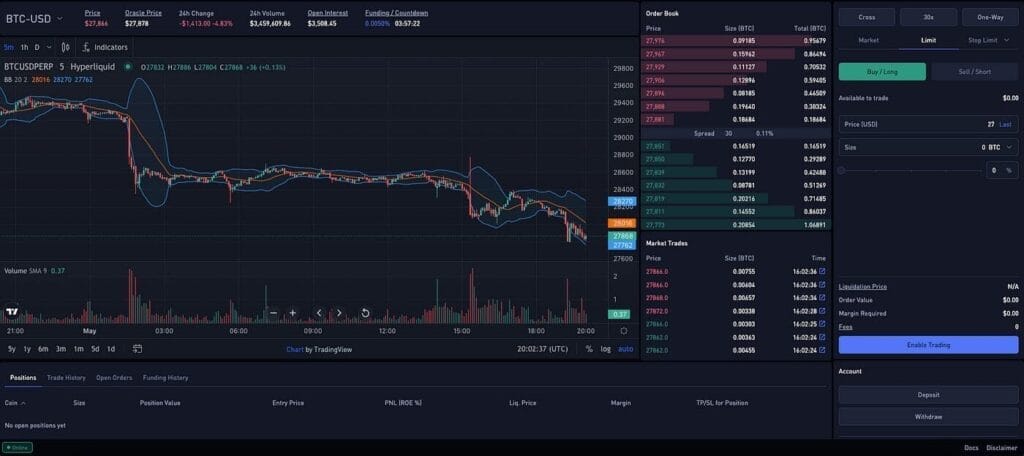
Hyperliquid is a high-speed perpetuals DEX running on a custom-built layer-1, engineered to deliver a CEX-like trading experience while remaining entirely on-chain. Its dedicated app-chain architecture prioritizes trading activity, providing rapid finality, deep liquidity, and minimal fees. For traders seeking professional-grade features—advanced order types, robust risk management, and frequent new market listings—along with opportunities for builders to introduce specialized pairs, Hyperliquid stands out as the “transparency-meets-performance” option.
Paradex

Paradex is a next-gen perpetuals DEX built on a ZK-rollup app-chain (via Starknet), designed to offer self-custody and CEX-level performance. Its architecture emphasises deep liquidity, portfolio-margin style risk, and innovative instruments like perpetual options. For traders after institutional-grade order-book experience plus privacy features and ultra-low latency, Paradex is the “institutional on-chain” pick.
Aden

ADEN is a decentralized perpetuals exchange built on proven infrastructure (notably the Orderly Network) with a strong emphasis on ultra-low fees and broad access. With full on-chain trade and liquidation automation plus very competitive trading costs, ADEN suits those who prioritise cost efficiency without sacrificing performance. The platform is a great match for traders wanting broad market access and low friction.
Pacifica

Pacifica is a Solana-native perpetuals DEX founded (in part) by a former major exchange executive, delivering fast rollout, high leverage and a mobile-friendly trading interface. Built for traders who demand “CEX speed + on-chain transparency,” Pacifica emphasizes user experience, multiple margin modes (isolated and cross) and rapid new market listings. If you’re looking for the “Solana-speed, high-leverage” option, Pacifica is it.
Extended
Extended is a perpetuals DEX developed by a team of former mainstream finance/tech professionals, aiming to merge perps, spot and lending into one unified margin ecosystem. With support for cross-asset collateral, both crypto and TradFi contracts, and a vision of seamless wallet and mobile integration, Extended is for the trader who wants “everything under one roof” rather than separate venues.
Hyperliquid vs Paradex vs Aden vs Pacifica vs Extended: Liquidity and Market Depth
Hyperliquid
- Runs on its own purpose-built Layer-1 blockchain designed for trading performance.
- Emphasises deep liquidity and low slippage compared to many on-chain DEXs.
- Reports very large asset deposits (over $1.3 billion since launch) which supports liquidity pools.
- Has experienced stress: one large liquidation (~$200 m) caused losses in the liquidity pool, prompting higher margin requirements.
- Ideal for mid-sized trades looking for tighter execution; still may face limits for very large tickets.
Paradex
- Built on a ZK-rollup / high-performance L2 architecture, focusing on “better-than-CEX liquidity” and institutional execution.
- Large recent volume: e.g., 30-day perp volume ~ $33.7 billion.
- Offers advanced order types, unified margin, and aims for portfolio-level risk controls.
- Depth metrics are still less publicly detailed (e.g., exact book depth, spread levels) compared to more mature platforms.
- Good pick for traders seeking institutional-grade liquidity but recommend verifying depth for your specific instrument.
Aden
- Built on the Orderly Network infrastructure; supports many chains and broad market access.
- Claims deep liquidity and strong trading volume: > $20 billion monthly volume and 200,000+ traders reported.
- Low-fee model and shared order-book design help pool liquidity across markets.
- Public transparency on order-book depth/spread is still limited.
- Well suited for traders who prioritise cost efficiency and broad access, while keeping an eye on actual depth for large size.
Pacifica
- Native to the Solana ecosystem; launched recently and already showing very high volume (~$440 million+ 24h).
- TVL is still relatively modest (~$30-$40 m) compared to volume.
- Because high trading volume is paired with lower locked capital, depth for very large trades may be less robust (higher slippage potential).
- Strong option for retail / mid-size traders seeking speed and interface polish in Solana; less certain yet for very large institutional-style trades.
Extended
- Focused on unified margin across spot, perp and lending, built on Starknet (and previously StarkEx) for high throughput.
- Recent metrics: 30-day perp volume ~$21 billion; TVL ~$95 million; open interest ~$80 million.
- Depth is still in growth phase — good for mid-sized trades, but may not yet match largest venues for ultra-large size.
- Best suited for traders using multi-asset strategies and looking for one ecosystem rather than many separate venues.
Also, you may read Hyperliquid vs AsterDex vs Drift
Hyperliquid vs Paradex vs Aden vs Pacifica vs Extended: Fees and Incentives
| Platform | Maker Fee | Taker Fee | Key Incentives / Notes |
|---|---|---|---|
| Hyperliquid | Starting ~ 0.010 % for lower tiers | Starting ~ 0.035 % for lower tiers | Volume-tier discounts + staking model offering fee reductions up to ~40% |
| Paradex | 0.015 % (perpetual futures) | ~0.015 % for futures, with some zero-fee promos (retail) | Retail zero trading fees for many markets; maker rebates possible |
| ADEN | ~ 0.00 % in some cases | ~ 0.009 % in some cases | Very low cost structure emphasized; broad market access being marketed |
| Pacifica | Tiered: 0.015 % at base tier | Tiered: 0.040 % at base tier | Fee levels drop with 14-day volume; still maturing platform |
| Extended | 0.000% (maker) | 0.025% (taker) | Maker rebates offered for high-volume providers; “gas-free” trading claimed |
Hyperliquid vs Paradex vs Aden vs Pacifica vs Extended: Security & Audits
Hyperliquid
Hyperliquid enhances user security through several key mechanisms. Its HyperBFT consensus algorithm provides strong fault tolerance and reliable performance even under high network load. Decentralized oracles aggregate pricing data from multiple sources, reducing the risk of manipulation and ensuring fair market valuations.
Additionally, community ownership—with no venture capital involvement—helps keep governance and decision-making aligned with user interests, reinforcing the platform’s integrity and trustworthiness.
Paradex
Paradex strengthens security through audited smart contracts, transparent uptime reporting, and verified domains to prevent phishing. Its on-chain trade-bust mechanism safeguards against excessive leverage, while zero-knowledge encryption ensures user privacy.
Built as a Stage 0 ZK rollup, it inherits Ethereum’s security but currently relies on an operator for sequencing—decentralization will expand via validator staking. Deposits use verified bridges like Rhinofi and LayerSwap, though users are urged to confirm addresses and start with small test transfers.
Aden
ADEN’s security framework integrates several specialized partners, each focused on a specific protection layer to ensure end-to-end safety for users and assets. CertiK conducts comprehensive smart contract audits, identifying vulnerabilities before deployment.
Guardian provides continuous multi-layer monitoring for real-time threat detection. Halborn reviews overall system architecture and backend resilience, while Sherlock performs penetration testing to simulate real-world attacks.
Zellic focuses on code optimization and security hardening for long-term stability, OtterSec secures cross-chain integrations, and Zenith audits protocol upgrades to ensure new releases meet strict safety standards. Together, these partners form a robust, multi-layer defense model across ADEN’s ecosystem.
Pacifica
Pacifica employs a non-custodial hybrid model, allowing users to trade directly from wallets like Phantom or Ledger, minimizing centralized fund risks. Its third-party smart contract audits aim to detect vulnerabilities pre-deployment, while a modular system architecture separates trading logic, wallets, and AI functions to reduce attack surfaces.
Dynamic margining and multi-source mark pricing enhance fairness and prevent manipulation, supported by three-tier liquidation protection (initial, backstop, and ADL) to contain volatility.
Hardware wallet integration strengthens key management, but as a new platform in closed beta, Pacifica still lacks a long-term operational record. Users should exercise standard DeFi precautions such as verifying URLs, testing small transfers, and tracking audit updates.
Also, you may read Hyperliquid vs AsterDEX vs Lighter vs edgeX vs Apex
Extended
Paradex employs a hybrid architecture where order matching, risk management, and sequencing occur off-chain, while settlement and validation are secured on-chain via Starknet. Users maintain full self-custody of their assets, ensuring the protocol cannot access or control funds.
Starknet was chosen for its security, performance, longevity, and aligned vision. The platform’s liquidation system includes an insurance fund, partial liquidations, and auto-deleveraging to manage risk during volatility.
Overall, security spans multiple layers—custody, settlement, risk engines, and contracts—though users should still follow standard DeFi safety practices such as securing wallets and staying informed about protocol updates.
Hyperliquid vs Paradex vs Aden vs Pacifica vs Extended: Comparative Analysis
| Platform | Architecture & Chain Design | Liquidity / Volume Highlights | Fee & Incentive Profile | Security / Audit Snapshot | Ideal User & Trade-Offs |
|---|---|---|---|---|---|
| Hyperliquid | Custom Layer-1 built specifically for trading (order-book on-chain) | 24-h perp volume ~ $5.96 b on the chain | Maker/taker tiers + staking discounts; deflationary mechanism with burn of ~97% of fees | Audit reports for specific modules; custom chain adds validator/chain risk | Pro/high-volume traders wanting CEX-level speed & liquidity; trade-off: new chain risk |
| Paradex | Hybrid: off-chain matching, on-chain settlement via Starknet app-chain | Strong emerging volumes; review shows deep liquidity ambition | Zero or ultra-low maker/taker for many users; airdrop / XP point programs | Audit coverage ~80-85% of codebase; infrastructure (roll-up, sequencing) still evolving | Institutional or sophisticated traders seeking unified margin; trade-off: infrastructure maturity still in progress |
| ADEN | Built on the Orderly Network infrastructure, multi-chain support | Monthly trading volume > $20 b, 200k+ traders reported | Extremely low trading fees (maker ~0%); broad market access | Multiple named security partners, but full audit reports less publicly visible | Cost-sensitive traders who want many markets; trade-off: less proven depth/maturity |
| Pacifica | Solana native, non-custodial hybrid architecture | Early stage but rapid growth in volume; still modest TVL | Launch incentives likely; fee details still evolving | Early-stage platform; less battle-tested; platform risk higher | Early adopters on Solana wanting new UX & speed; trade-off: higher platform risk |
| Extended | Unified margin (Spot + Perp + Lending) on Starknet-style architecture | TVL ~$95–$100 m; 30-day volume ~$21 b; open interest ~$80 m | Maker rebates + low taker fees; multi-product exposure | More complex architecture increases risk surface; audit/transparency still catching up | Advanced traders wanting multi-asset exposure; trade-off: complexity & higher structural risk |
Conclusion
Each platform represents a distinct approach to decentralized perpetual trading. Hyperliquid leads in speed, liquidity, and professional-grade tooling through its custom L1. Paradex combines Starknet’s scalability with hybrid execution for institutional-level reliability.
ADEN emphasizes accessibility and ultra-low fees with a growing multi-chain ecosystem. Pacifica leverages Solana’s performance in a non-custodial, modular setup for early adopters, while Extended targets advanced traders seeking unified margin across assets.
In essence, Hyperliquid and Paradex dominate the high-performance segment, ADEN and Pacifica focus on inclusivity and innovation, and Extended bridges multi-asset exposure — giving users a range of options based on risk appetite and trading sophistication.
Frequently Asked Questions
Are my assets custodied by the platform?
On these platforms (especially Paradex and similar), assets remain in your wallet until you trade. The platform claims no custodial control over user funds, relying on on-chain settlement/validation. For example, Paradex states users retain self-custody.
How are fees and incentives handled?
Fee structures vary by platform — some offer zero maker/taker fees for certain users, volume tiers, staking discounts or XP/reward programs. For example, Paradex has an XP-based reward structure.
What chain does Paradex run on?
It runs on its own Layer-2, DimeVM (StarkNet-stack), designed for high throughput, low fees, zk-encrypted privacy, and composability with the broader ecosystem.
What is the long-term vision for Extended?
Extended plans to evolve into an EVM-compatible network built on Starknet, embedding unified margin logic at the base layer to enable shared liquidity, seamless cross-dApp margining, and a fully open financial ecosystem.
Who controls the assets on ADEN?
Users have full self-custody of their assets. ADEN operates on a non-custodial model, meaning funds remain in your wallet and are only managed through secure on-chain smart contracts.