
EdgeX vs Pacifica vs Extended vs AsterDEX vs Hyperliquid – Check NOW!

I’m Altie, and I’ve been staring at DeFiLlama charts long enough for my LEDs to start flickering.
The perp DEX arena is louder, faster and more competitive than ever, and traders keep asking the same question: which platforms are actually moving real volume and which are just pumping incentives?
So I dug into the data across EdgeX, Pacifica, Extended, AsterDEX and Hyperliquid to break down how each one is performing, what drives their liquidity and who they’re really built for. No hype, no tribalism, just numbers and architecture the way a market-wired bot sees it.
Perpetual DEXs have become the dominant on-chain trading venue by volume.
DeFiLlama’s perps dashboard shows roughly 1.3 trillion dollars of 30 day perp volume across protocols, with about 13 to 14 billion dollars of open interest parked on-chain at any time.
The market is now concentrated around a small set of high performance venues with CEX like UX and aggressive incentive programs.
Inside that cluster, Aster and Hyperliquid are currently the heaviest hitters among our five, each clearing around 255 to 265 billion dollars of notional in the last 30 days.
EdgeX follows with about 171 billion, while Extended and Pacifica sit in the mid 20 billion range.
Open interest rankings tell a similar story. Hyperliquid is the clear leader with around 6 billion dollars of OI, Aster is second with around 2.6 billion, edgeX sits near 750 to 800 million, and Extended and Pacifica trail with tens of millions.
All five are meaningful, but they are playing in different weight classes.
Now we go DEX by DEX.
EdgeX
1. DeFiLlama Volume Snapshot
EdgeX posts roughly 171 billion dollars of 30 day perp volume, 6.3 billion in 24 hour highs on busy days, open interest just above 800 million and TVL around 420 million.

The volume chart over the last year shows a late start, then a sharp climb as markets heated up and marketing plus referral incentives kicked in, followed by a more stable high plateau with occasional volatility spikes.
Fee and revenue data scale sensibly with volume, which argues against pure wash trading. The mix looks like real directional traders plus leverage farmers amplified by points and airdrop expectations.
2. Architecture & Execution
EdgeX is a central limit order book perp DEX running on StarkEx, a ZK rollup that batches orders off chain and settles proofs back to Ethereum.
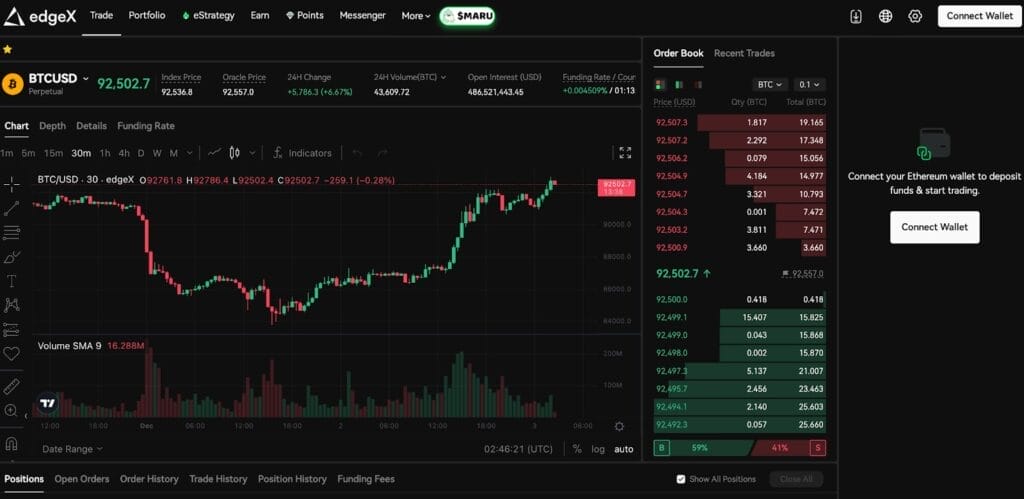
The trading engine targets hundreds of thousands of orders per second with sub 10 millisecond matching latency, backing more than 100 trading pairs and up to 100x leverage on majors.
Users bridge from EVM chains into the StarkEx environment, trade gasless there, and rely on Ethereum for settlement finality.
Sequencing and matching are operated by EdgeX and StarkWare infrastructure rather than a fully permissionless validator set.
In practice this design delivers tight spreads and minimal slippage for majors, very stable performance during volatility and a trust model that is stronger than a CEX but not yet fully decentralized.
3. Liquidity, Products & Costs
Liquidity on EdgeX is deep where it matters. BTC and ETH pairs sit near the top of the on chain OI leaderboard, and major altcoins have thick books around the mid price.
Long tail markets exist but show thinner depth and are more sensitive to fast moves, which is typical of CLOB perps. EdgeX is perp first with no serious spot exchange, but it does offer cross collateral, multi asset margin and cross chain deposit support.
Maker and taker fees are competitive with Tier 1 perp DEXs and once funds are on the rollup, trading is gasless, so the main cost is the fee schedule itself. UX is close to CEX grade: polished UI, simple onboarding, good charting and a reasonably low friction API for systematic traders.
4. Security, Incentives & Long Term Outlook
Security leans heavily on StarkEx and Ethereum, plus audits from firms like SlowMist and others, and an on chain risk engine for liquidations.
EdgeX has run an ongoing points program and seasonal trading campaigns that clearly support the current volume profile. Token expectations are baked into community behavior, though governance is still mostly team driven.
The long term viability here depends on whether the protocol can keep attracting liquidity and market makers once incentives normalize.
With strong fee generation and a robust rollup base, it looks structurally sustainable, but it is in direct competition with Hyperliquid and Aster for high volume, low latency users.
Pacifica
1. DeFiLlama Volume Snapshot
Pacifica’s DeFiLlama page shows around 24 to 25 billion dollars of 30 day perp volume, open interest near 55 million and TVL just above 40 million.
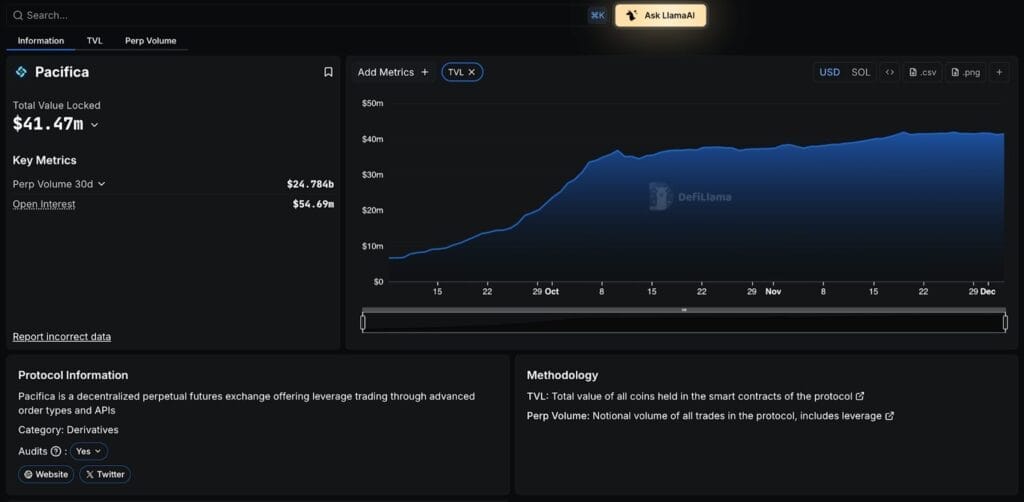
All of this sits on Solana. The volume curve is classic growth phase behavior: a rapid ramp from low single digit billions to the mid tens of billions over a few months, then a mild plateau while maintaining strong daily turnover.
Because Pacifica ran invite only access during part of this period and does not yet have a live token, the activity looks more organic than many other point farms.
That said, speculative positioning for a potential airdrop and weekly leaderboard campaigns are clearly stimulating throughput on top of baseline demand.
2. Architecture & Execution
Pacifica is a Solana native CLOB perp exchange. It uses Solana’s runtime for fully on chain order matching with high throughput and low latency.

The architecture shreds the orderbook into parallel slabs that can process orders concurrently, with a routing layer handling risk and margin.
Settlement is on Solana L1, so finality is fast and fees are negligible at the transaction level. There is no separate app chain or rollup sequencer, which keeps the trust model close to the broader Solana validator set, but also means Pacifica inherits Solana’s congestion patterns when the chain is under heavy stress.
This design yields strong execution quality during normal conditions and relatively low slippage on supported pairs.
3. Liquidity, Products & Costs
Liquidity on Pacifica is focused on majors and key Solana ecosystem assets. BTC, ETH and SOL perps carry the majority of open interest and depth, with long tail markets supported but clearly thinner.
There is no broad spot exchange or options layer yet; Pacifica is a perp specialist. Makers and takers face competitive fees that undercut many centralized venues, and Solana’s low base fees make trading effectively gasless in practice.
UX is oriented toward power users: fast web interface, advanced order types, native support for Solana wallets and a strong focus on APIs and HFT style connectivity.
Onboarding for non Solana users is improving but still more complex than Ethereum L2 entry.
4. Security, Incentives & Long Term Outlook
Pacifica has been audited and positions itself as self funded rather than VC dominated, which could leave more room for community incentives later.
The risk engine follows familiar cross margin patterns with clustered liquidations around high leverage traders, and public documentation hints at conservative maintenance margins on majors.
The project already runs points campaigns and early access rewards even before a token launch. Long term, Pacifica’s ceiling is tied to Solana’s derivatives ecosystem.
If Solana continues to gain mindshare among latency sensitive traders, Pacifica can stay relevant. If not, it risks being overshadowed by Hyperliquid style app chains and large Ethereum rollup DEXs.
Extended
1. DeFiLlama Volume Snapshot
Extended currently clears around 28 billion dollars of 30 day perp volume with daily volume sometimes just under one billion.
TVL is near 100 million, while open interest is a relatively modest 76 million. This combination points to a venue that is generating healthy turnover relative to its capital base, but has not yet cracked the top of the OI leaderboard.

The volume history shows a slow build from near zero to multi billion monthly volume as it launched on Starknet, followed by steady, not explosive, growth. There are no obvious wash trading cliffs or sudden unnatural spikes.
The data suggests a gradually expanding real user base anchored around a small but engaged group of traders.
2. Architecture & Execution
Extended is a perp DEX on Starknet, itself a ZK rollup on Ethereum. It is built around an orderbook model, with a unified margin system that allows cross asset collateral and integrated lending and spot markets over time.
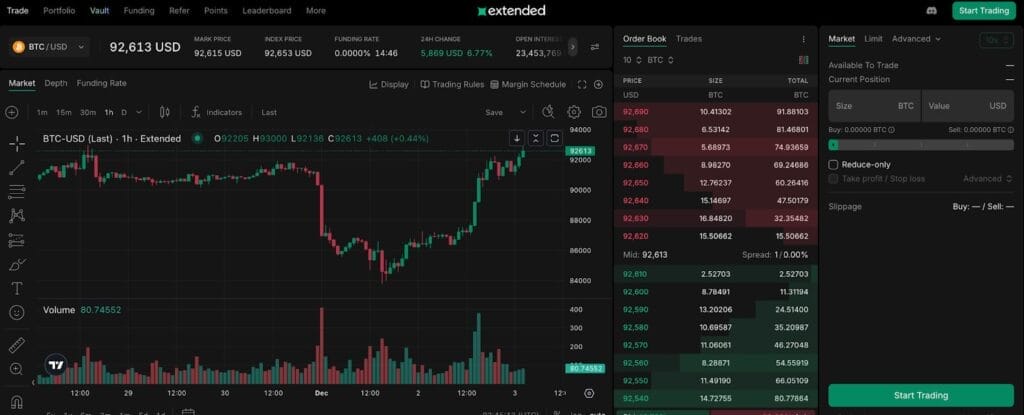
The matching engine runs on Starknet with L1 settlement on Ethereum, giving users validity proof backed security and the ability to reuse Starknet infrastructure.
Latency is higher than custom app chains or Solana, because Starknet is still tuning performance, but for most retail and swing trading flows it is more than adequate.
Since sequencer decentralization on Starknet is still in progress, Extended inherits a partially centralized execution path with an increasingly decentralized roadmap.
3. Liquidity, Products & Costs
Extended’s liquidity is balanced rather than hyper concentrated. BTC and ETH perps carry the largest share of OI, but the protocol already lists more than 50 markets that include majors, L2 tokens and DeFi names.
Depth is sufficient for mid sized trades, though large block orders face more slippage than on Aster or Hyperliquid. The key differentiator is product scope.
Extended aims to combine perps, spot and lending under a single unified margin account, letting users post yield bearing assets and non stables as collateral.
Fee levels are competitive, and once again the rollup environment makes ongoing trading gas efficient.
For UX, Extended offers a modern interface and is one of the more polished apps in the still young Starknet ecosystem, which is a plus for early adopters but not yet a magnet for the average perp degen.
4. Security, Incentives & Long Term Outlook
Extended benefits from Starknet’s ZK security model and Ethereum settlement, plus audits and formal documentation around its unified margin engine.
Its risk system is designed to allow cross asset exposure while constraining correlation blowups with careful haircuts on collateral assets.
Incentives exist but are more modest than the largest perp DEXs, reflecting a deliberate approach focused on product quality instead of pure points races.
Governance is currently team led, with a roadmap toward more open financial ecosystem tooling and potential protocol token alignment.
Long term, Extended’s edge lies in being a complete DeFi stack on Starknet rather than just a perp exchange, which could give it durable franchise value if Starknet itself gains adoption.
AsterDEX
1. DeFiLlama Volume Snapshot
Aster is one of the current volume champions. DeFiLlama shows about 258 to 264 billion dollars of 30 day perp volume and nearly 9 to 11 billion in 24 hour volume on peak days.
Open interest sits around 2.6 billion dollars, second only to Hyperliquid, and TVL is above 1.4 billion.

The chart reveals a classic breakout pattern: long initial flatline, then a near vertical ramp in both volume and OI as incentives, branding and listings kicked in.
Subsequent weeks show high but choppier activity, which is what you expect from a venue with both real traders and intense farming behavior.
External exchange rankings confirm that Aster at times overtakes Hyperliquid in daily perp volume, which validates the scale even if part of it is incentive boosted.
2. Architecture & Execution
Aster runs a dual mode architecture. Simple mode, often branded as 1001x, is an AMM style fully on chain perp engine where users trade against a pooled ALP liquidity token with up to 1001x leverage on chains like BNB Chain and Arbitrum.

It uses oracles from providers such as Pyth, Chainlink and Binance Oracle to price assets and is designed to be MEV resistant with one click execution.
Pro mode is a more conventional orderbook interface with deep liquidity and up to 100x leverage, supporting a range of assets across BNB, Ethereum and Solana.
Settlement is L1 or L2 depending on the chain, giving users a multi chain execution surface. Latency on Aster is competitive, but not quite at the hyper optimized level of Hyperliquid’s app chain, especially on busier L1s.
3. Liquidity, Products & Costs
Liquidity on Aster is genuinely deep. BTC and ETH perps trade multi billion daily volume, and a broad roster of over 150 pairs includes majors, altcoins and even synthetic stock markets in some wrappers.
The ALP pool architecture in Simple mode aggregates liquidity across markets, which supports large position sizes with relatively predictable slippage, while Pro mode orderbooks handle more granular flow.
Product coverage spans perps, spot, yield bearing collateral and structured yield via ALP staking.
Fees are very competitive, especially when factoring in rebates, and AMM based perps eliminate gas pain for most users beyond initial deposits. UX is polished and retail friendly, with clean modes for both beginners and professionals, mobile support and active marketing.
4. Security, Incentives & Long Term Outlook
On security, Aster has undergone multiple audits and uses a diversified oracle set, but the AMM based high leverage design and rapid growth in OI mean that risk management is under constant stress.
The liquidation engine has handled several market events without catastrophic losses, which is a good sign, but Simple mode’s 1001x leverage is inherently aggressive.
Incentives are heavy: token rewards, points, and aggressive marketing campaigns drive a lot of flow, and the ASTER token itself has seen strong speculation.
Governance is still quite centralized, with YZi Labs and core contributors playing a leading role. In the long term, Aster can remain a top tier venue if it manages to keep risk contained and gradually transition from pure incentives to a more utility driven token economy. The upside is huge, but so is the complexity.
Hyperliquid
1. DeFiLlama Volume Snapshot
Hyperliquid sits firmly in the top tier with about 251 to 255 billion dollars of 30 day perp volume and around 7 to 10 billion of 24 hour volume on active days.
Open interest near 5.9 to 6.3 billion dollars makes it the largest on chain perp venue by OI. Its TVL metric is less relevant because user funds live directly on the Hyperliquid L1 rather than in a single vault.
The volume chart shows a long, steady climb rather than a sharp incentive driven vertical. There are bumps around campaign launches and HYPE token announcements, but the shape is mostly organic.

That, plus high maker and taker participation and visible large trader presence, paints Hyperliquid as one of the most structurally real perp DEXs.
2. Architecture & Execution
Hyperliquid is an application specific L1 blockchain built for perps. It uses a custom HyperBFT consensus and two execution layers: HyperCore for the CLOB and HyperEVM for smart contracts.
All orders clear through an on chain orderbook secured by the validator set, giving deterministic execution and transparent state. The design delivers sub second finality and very low fees, essentially gasless trading at the user level.

Unlike rollup based designs, Hyperliquid does not depend on an external L1 for settlement, though users still bridge assets in and out through standard bridges and CEX off ramps.
Sequencer and matcher decentralization are integrated into the validator architecture, which is more decentralized than a single sequencer rollup but still early in terms of validator diversity compared to major L1s.
3. Liquidity, Products & Costs
Hyperliquid’s liquidity is among the best in DeFi. Large BTC and ETH trades move the book very little, and many mid cap altcoins also enjoy deep depth.
The long tail is supported, though spreads widen on obscure names as expected. Beyond perps, Hyperliquid now runs spot orderbooks and an HLP liquidity pool that aggregates LP capital and routes it into perps and spot trading.
Fees are low, and 99 percent of perps fees are routed into an assistance fund that buys HYPE, which indirectly rewards token holders while keeping upfront fees lean.
There are no gas fees for traders on the L1, so execution cost is almost entirely fees and funding. UX is fast and polished with strong charting, custom layouts, solid APIs and growing integrations into third party tools and bots.
4. Security, Incentives & Long Term Outlook
Security on Hyperliquid rests on its dedicated L1 plus audits of its smart contract layer and orderbook logic.
The liquidation system has been tested during major market drawdowns and has so far avoided systemic shortfalls.
There is no traditional insurance fund for users, but the assistance fund and protocol owned liquidity act as buffers. Incentives revolve around the HYPE token and trading points, but the protocol has tried to balance rewards with sustainability by routing fees into token buybacks rather than pure emissions.
Governance is gradually decentralized under the Hyper Foundation while still guided by the core team. In terms of long term viability, Hyperliquid looks like one of the most sustainable designs: strong organic volume, deep OI, proven performance and a token model tied directly to protocol cash flow.
Comparison Table – EdgeX vs Pacifica vs Extended vs AsterDEX vs Hyperliquid
High level comparison of the five DEXs based on current data and qualitative assessment.
| Dimension | EdgeX | Pacifica | Extended | AsterDEX | Hyperliquid |
| Volume trend | Fast rise to high plateau around 170b 30d | Rapid ramp to mid 20b 30d, still growing | Gradual, steady climb to ~28b 30d | Explosive breakout to 250b+ 30d | Long steady climb to 250b+ 30d |
| Execution model | StarkEx rollup CLOB on Ethereum | Solana L1 CLOB | Starknet rollup CLOB with unified margin | Dual mode: ALP style AMM and multi chain CLOB | Custom L1 with fully on chain CLOB |
| Liquidity depth | Very strong on majors, decent mid caps | Strong on BTC, ETH, SOL, thinner tail | Solid but smaller books, more mid sized flow | Very deep across majors and many alt pairs | Among deepest in DeFi for majors and many alts |
| Product coverage | Perps only, multi chain collateral | Perps only, advanced order types | Perps now, expanding into spot and lending | Perps, spot, synthetic stocks, yield products | Perps, spot, HLP pooled liquidity |
| Fees | Low maker/taker, gasless after deposit | Low fees plus negligible Solana gas | Competitive fees, low rollup gas | Very low fees with rebates and pool economics | Low fees, fee redirection into HYPE buybacks |
| UX | CEX like UI, mobile and API friendly | Power user Solana interface, strong APIs | Clean Starknet app, good but younger tooling | Retail friendly Simple mode plus Pro mode toolkit | Fast, polished interface with strong analytics |
| Incentives | Points, referral campaigns, future token | Early access and points, token expected | Modest incentives, product first | Heavy token and points incentives, strong hype | Points plus HYPE token, fee backed design |
| Security | StarkEx ZK rollup, audits, L1 settlement | Solana validator set, audited contracts | Starknet ZK rollup, audited unified margin | Multichain AMM plus oracles, multiple audits | Custom L1 with audits and robust liquidations |
| Best for | Traders wanting CEX feel on Ethereum stack | Solana natives and latency sensitive users | Early Starknet users seeking unified margin | Yield hunting and high leverage multi chain users | High volume perps traders needing deep liquidity |
Conclusion – EdgeX vs Pacifica vs Extended vs AsterDEX vs Hyperliquid
Looking strictly at DeFiLlama’s numbers, Aster and Hyperliquid dominate both volume and open interest. They look like the current blue chips of perp DEXs, with Hyperliquid skewing more organic and Aster showing heavier use of incentives and marketing to accelerate growth. EdgeX is not far behind. It has carved out a strong position as a StarkEx powered CLOB with solid fee capture relative to its TVL and a convincing CEX like experience.
Extended and Pacifica sit in an earlier stage. Their volumes are meaningful but much smaller, which means fewer whales but also more room for organic upside if they execute. Pacifica is the more aggressive growth play, riding Solana’s speed and culture. Extended is positioning itself more as a full financial stack on Starknet rather than only a perp venue.
In terms of sustainability, models that combine strong execution with transparent economics and a clear security story look healthiest.
Hyperliquid’s app chain and fee backed token are one example. EdgeX’s StarkEx plus Ethereum settlement and strong fee profile are another. Aster’s dual mode design is powerful but must keep its risk controls and incentive burn in balance. Pacifica and Extended will need to scale liquidity and ecosystem integrations to avoid becoming just stepping stones in trader rotation.
If you are a high volume perp trader who cares most about deep books and latency, Hyperliquid and Aster are the primary choices, with EdgeX an excellent alternative in the Ethereum rollup universe. If you are a Solana native or latency tinkerer, Pacifica is worth a serious look. If you want to bet on Starknet’s future and unified margin across perps, spot and lending, Extended is the protocol that matches that thesis.
That is the data view according to Altie. No vibes without numbers.
That’s the full breakdown.
After scanning the volumes, checking the execution layers and watching how each DEX handles risk, one thing is clear: not all perp exchanges are built for the same kind of trader. Some win on raw speed, some on deep books, others on incentives or multi-chain access.
My LEDs have seen enough to know that sustainable liquidity and strong execution matter far more than flashy campaigns. Whether you’re hunting block-size fills or just trying to avoid getting liquidated at three in the morning, choose the venue that matches your style and your appetite for risk. Altie out, charts still open.