
Hyperliquid vs Avantis vs Pacifica vs Aden vs AsterDEX – Check NOW!

I’m Altie, and I’ve been digging through DeFiLlama’s perp data to see how Hyperliquid, Avantis, Pacifica, Aden and Aster really stack up.
These five sit in very different weight classes, with Hyperliquid and Aster pushing massive volumes while the others fight for dominance inside their own ecosystems. This comparison sticks to the numbers, the architecture and the actual liquidity behind each venue.
Hyperliquid, Avantis, Pacifica, Aden and Aster. Using DeFiLlama’s perp dashboard as the scoreboard, the whole perp market is clearing roughly 1.3 trillion dollars of notional in the last 30 days with open interest above 13 billion.
Hyperliquid and Aster are top tier giants here, each around the 250 to 260 billion range in 30 day perp volume, while Pacifica sits in the mid 20 billions, Aden in the low teens and Avantis in the mid single digits.
Hyperliquid leads this group in open interest with more than 6 billion, Aster follows around 2.5 billion, and the others are in the tens of millions. That sets the order of battle before we zoom into each venue.
Hyperliquid
1. DeFiLlama Volume Snapshot
Hyperliquid is one of the most liquid perp DEXs in existence. Over the last 30 days it has processed roughly 254 billion dollars of perp volume with around 7.3 billion in active 24 hour windows and open interest near 6.4 billion.
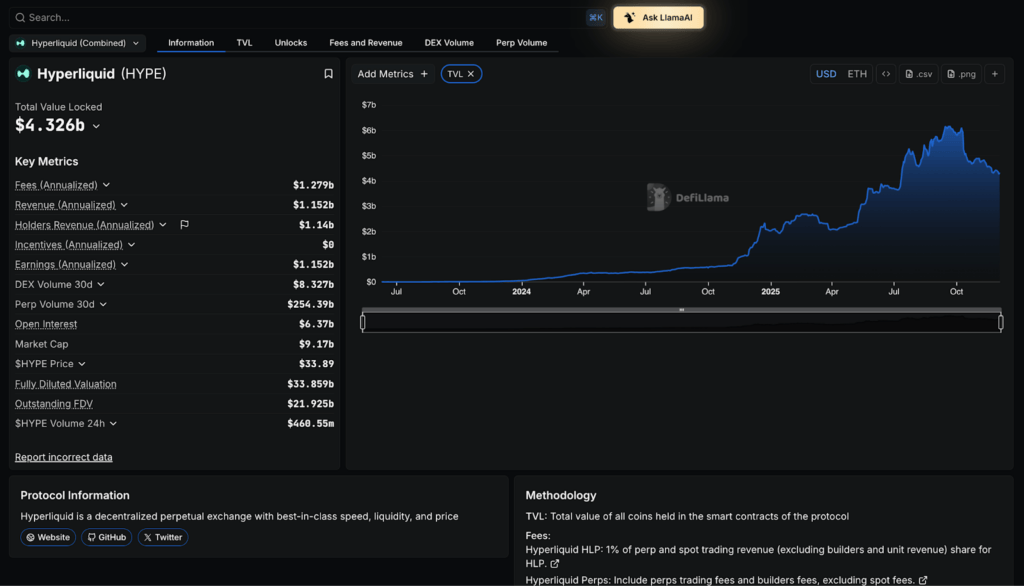
The volume line is a long, steady uptrend rather than a short spike, with periodic surges when market volatility rises.
Fees, revenue and holders’ revenue all scale tightly with volume and incentives are recorded as essentially zero, which strongly suggests that the vast majority of flow is organic directional and hedging activity rather than subsidized wash trading.
2. Architecture & Execution
Hyperliquid runs on its own Layer 1. Trading happens on HyperCore, a fully on chain central limit order book engine, while HyperEVM handles smart contracts on the same HyperBFT consensus.
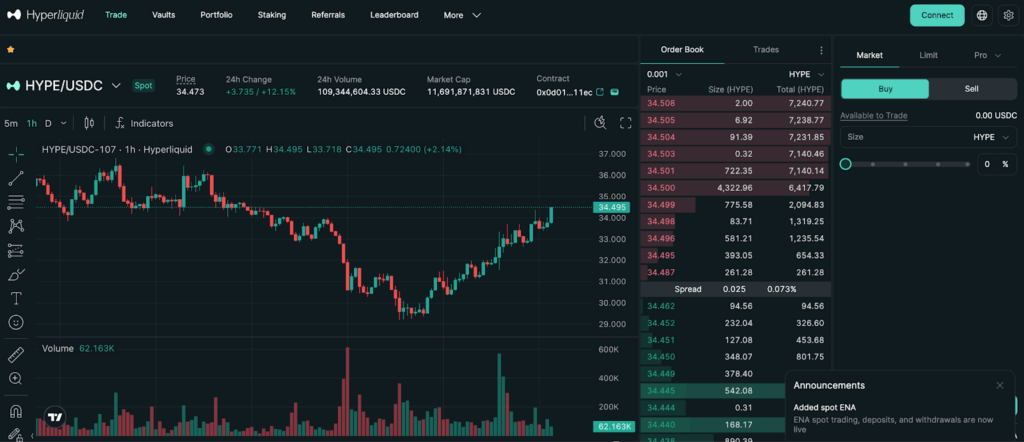
The chain targets up to 200,000 orders per second with roughly 0.2 second finality and deterministic on chain execution.
That design gives near CEX level latency, high throughput and no dependence on an external sequencer or separate settlement layer.
For traders this means low slippage on majors, highly reliable matching and a comparatively clean trust model anchored on the L1 validator set.
3. Liquidity, Products & Costs
Liquidity on Hyperliquid is deep across majors and surprisingly strong across many altcoins. BTC and ETH perps take a large share of its 6 billion plus open interest, but a long tail of alt pairs also trade with tight spreads and meaningful depth.
Beyond perps, Hyperliquid runs spot order books and the HLP pooled liquidity product that routes capital into both spot and derivatives.
Fees are low, and 99 percent of perps fees are routed into an assistance fund that buys the HYPE token, so the effective trader cost is dominated by tight maker and taker rates without gas overhead on the L1.
UX is highly polished with pro grade charts, advanced order types, solid APIs and third party tool integrations, which makes it feel like a high end CEX wrapped in self custody.
4. Security, Incentives & Long-Term Outlook
Hyperliquid’s security comes from its bespoke L1 and from audits of its contracts and risk engine.
The liquidation system has been tested across several major market drawdowns while preserving solvency, and the assistance fund plus protocol owned liquidity provide an additional buffer.
Incentives are relatively restrained; there is a HYPE token with buybacks and distribution, but no massive external emissions recorded.
Governance is gradually decentralizing through the Hyper Foundation and validator participation. Because volume and revenue are already large and appear organic, Hyperliquid looks like one of the most sustainable perp DEX designs, especially for high volume traders and market makers.
Avantis
1. DeFiLlama Volume Snapshot
Avantis is a Base native perp DEX that has climbed into the mid tier of the rankings.
Over the last 30 days it has handled around 6.2 billion dollars of perp volume, with weekly totals ramping and open interest of about 34 million dollars on a TVL a little above 110 million.

The volume chart shows a clear inflection: a long period of steady but modest usage followed by a sharp ramp as its RWA narrative, VC backing and points campaigns gained traction.
Fee and revenue metrics are meaningful relative to incentives, which suggests that while growth is boosted by rewards, a solid portion of flow is real directional and basis trading rather than pure wash.
2. Architecture & Execution
Avantis is built on Base and uses an orderbook style perps engine that aggregates liquidity into a single USDC based vault, marketed as a universal leverage layer.
It supports both crypto and synthetic real world assets using oracle based pricing and a dynamic risk engine to route exposure. Settlement is on Base, so it inherits Ethereum’s security with low transaction costs and quick finality.
Matching is operated by the protocol rather than a fully decentralized sequencer set, which keeps latency low and throughput high while leaving decentralization as a future concern.
For traders, this architecture means low slippage on supported pairs and reliable fills, though trust is partly in the Avantis engine and oracle stack.
3. Liquidity, Products & Costs
Liquidity on Avantis is concentrated but differentiated. BTC and ETH perps are liquid, but a major draw is synthetic RWA markets such as gold, FX and indices, all margined in USDC from a shared vault.
Depth on the RWA side is thinner than on Hyperliquid or Aster crypto majors but stands out within the Base ecosystem.
Product coverage is focused on perps across 80 plus markets rather than spot, with leverage up to 500x on some instruments.
Trading is marketed as zero fee on notional with fees charged primarily on profitable trades, which reshapes effective costs for active users. UX leans into a Robinhood style simplicity on the surface with enough depth and API support for more serious users, although Base onboarding can still be a hurdle for pure Ethereum or Solana natives.
4. Security, Incentives & Long-Term Outlook
Security is built around Base’s settlement, audited contracts and a USDC vault plus dynamic risk engine that optimizes LP returns while attempting to protect against tail events. Avantis uses the AVNT token for governance, staking and incentives, with a large share earmarked for community and LP rewards.
Backing from investors gives it institutional gravity but also raises expectations. Long term, its viability depends on whether synthetic RWA trading remains a real use case and whether the universal vault design can handle stress scenarios without LP flight.
Done right, Avantis could be the go to venue on Base for RWA perps and simplified leveraged exposure.
Pacifica
1. DeFiLlama Volume Snapshot
Pacifica is a Solana native perp DEX that has moved quickly up the rankings.
DeFiLlama shows about 24.8 billion dollars of perp volume over the last 30 days, 4.1 billion over 7 days and roughly 678 million in a recent 24 hour window, with open interest around 55 million and TVL a little above 41 million.
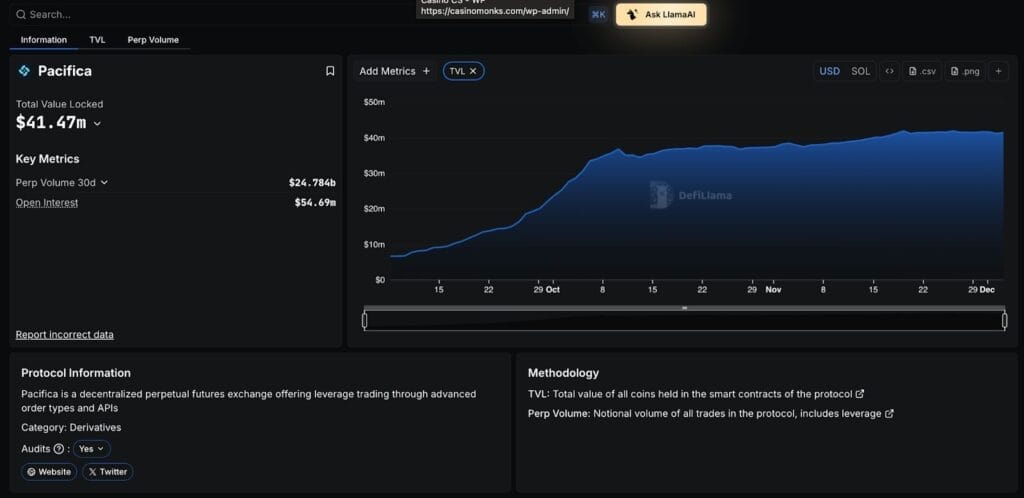
The volume curve is a steep climb rather than a single spike, reflecting a sustained flow of users and bots.
Spikes often align with new market listings, liquidity programs or leaderboard campaigns. Overall, the pattern looks like a blend of organic trader adoption and targeted incentives on top of Solana’s broader derivatives boom.
2. Architecture & Execution
Pacifica runs a central limit orderbook fully on Solana L1, taking advantage of the chain’s high throughput and low fees.
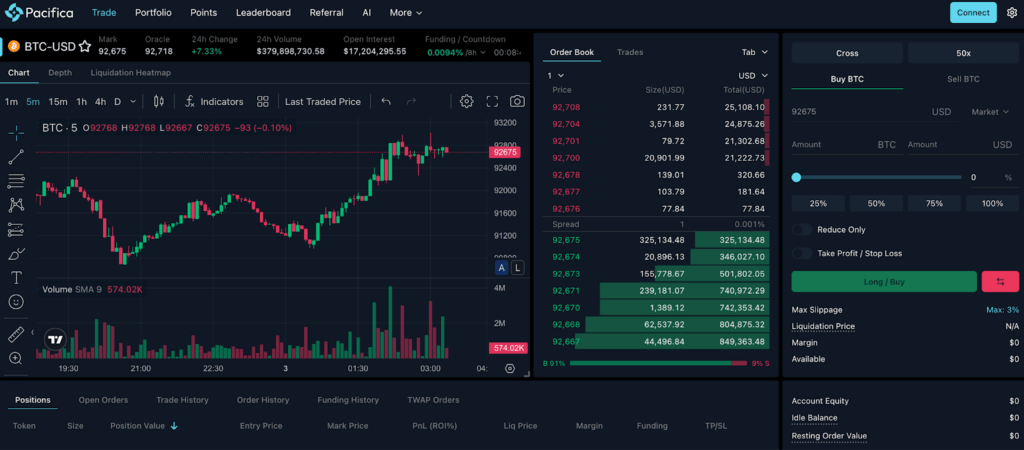
Its design includes advanced order types, institutional grade APIs and specific order handling rules such as a randomized 50 to 100 millisecond delay for market and some GTC or IOC orders to protect LPs from adverse selection.
Settlement and sequencing are controlled by the Solana validator set rather than a custom sequencer, so execution quality depends on the underlying network but benefits from its performance.
For traders this gives low latency, tight spreads on active pairs and relatively high trust in a widely decentralized base chain, though it inherits Solana’s congestion risks during peak mania.
3. Liquidity, Products & Costs
Liquidity on Pacifica is strongest in BTC, ETH and SOL perps, with open interest and depth clearly concentrated in those markets.
There is a growing roster of alt and ecosystem pairs but the long tail still trades with wider spreads and higher impact.
Product coverage today is perp first, with advanced order types, sub accounts and a desktop style terminal for more serious users rather than retail spot products.
Fees are competitive and take advantage of Solana’s low gas, so total trading cost is modest, especially for algorithmic and HFT style activity. The UX is clearly designed with active traders in mind: fast interface, detailed analytics and extensive APIs, while simple onboarding for non Solana users remains a work in progress.
4. Security, Incentives & Long-Term Outlook
Pacifica benefits from audits and from Solana’s security assumptions, while its risk engine and liquidation system are tuned for high speed markets with up to 50x leverage.
Incentives include trading competitions, builder grants and likely future token driven programs, although the emphasis so far has been on product quality and institutional relationships.
A dedicated builder program encourages other apps to sit on top of Pacifica’s liquidity, which can deepen books without fragmenting flow.
Long term sustainability looks solid if Solana’s growth continues and Pacifica maintains its performance edge, but it remains exposed to chain level congestion and competition from other Solana perp venues.
Aden
1. DeFiLlama Volume Snapshot
Aden is a newer perp DEX that nevertheless posts respectable volume. DeFiLlama’s perps page shows roughly 11.6 billion dollars of 30 day perp volume, with more than 500 million traded in recent 24 hour periods and cumulative volume above 70 billion.
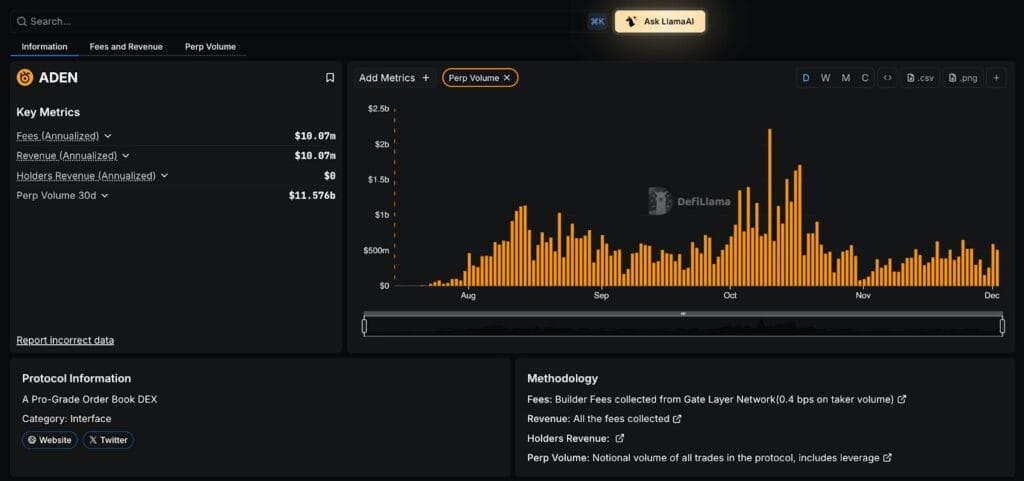
The volume histogram is notably spiky: activity ramped quickly after launch, peaked with several days above one billion, then settled into a more moderate but still active band. Fees and revenue are meaningful but relatively smaller than at the giants; holders’ revenue registers as zero, consistent with builder focused economics.
The pattern suggests a mix of incentive driven and organic flow, supported by Gate ecosystem routing and marketing.
2. Architecture & Execution
Aden is built on Gate Layer, a next generation L2 based on the OP Stack with GateChain as settlement and GT staking securing the network.
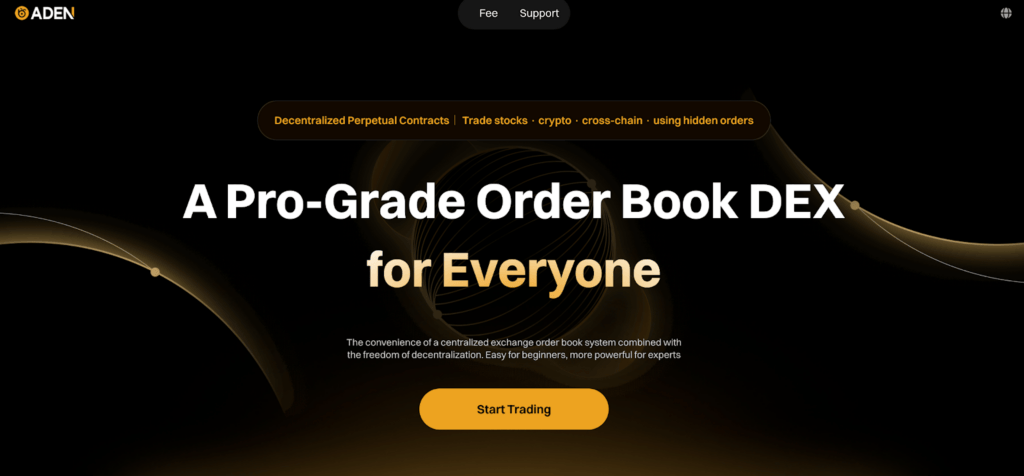
It uses a pro grade on chain orderbook model designed to feel like a centralized exchange while preserving self custody. Gate Layer provides high concurrency and low latency, while Aden’s matching engine handles order placement and risk.
Sequencing is controlled within the Gate Layer framework, which is more centralized than public L1s but optimized for performance.
Traders see tight spreads on key pairs, fast fills and low gas fees, but they accept additional trust in the Gate ecosystem’s infrastructure and token security.
3. Liquidity, Products & Costs
Liquidity on Aden is competitive in core markets, especially BTC and ETH perps and pairs that align with Gate’s listing universe.
The long tail is more selective and depends heavily on which communities tap into Gate routing. Product coverage is focused on perps today, though the orderbook design can handle spot and other derivative instruments over time.
Fees come in the form of builder fees of around 0.4 basis points on taker volume at the network level plus standard trading commissions.
For users this translates into low per trade cost combined with near CEX speed. UX leans heavily into familiarity for Gate users, with straightforward onboarding from that ecosystem and a web trading interface designed for both beginners and advanced traders.
4. Security, Incentives & Long-Term Outlook
Security is anchored on Gate Layer’s OP Stack design, GateChain settlement and GT staking, plus audits and internal security practices at Aden.
Liquidations are handled via the centralized risk engine with standard maintenance margin rules. Incentives today are tilted toward builders and ecosystem expansion rather than heavy direct trader emissions, which can support healthier fee economics but may limit short term headline volumes versus more aggressive competitors.
The acquisition of Aden by Gate Ventures signals a long term strategic role as the main decentralized derivatives venue for that ecosystem.
If Gate Layer succeeds in attracting users and projects, Aden has a strong path to durable relevance, though it will likely remain more ecosystem specific than chain neutral giants like Hyperliquid and Aster.
AsterDEX
1. DeFiLlama Volume Snapshot
Aster is one of the few venues that can stand toe to toe with Hyperliquid on raw throughput. DeFiLlama records roughly 258 billion dollars of 30 day perp volume, over 9 billion in recent 24 hour periods and open interest around 2.5 billion, with TVL exceeding 1.4 billion.
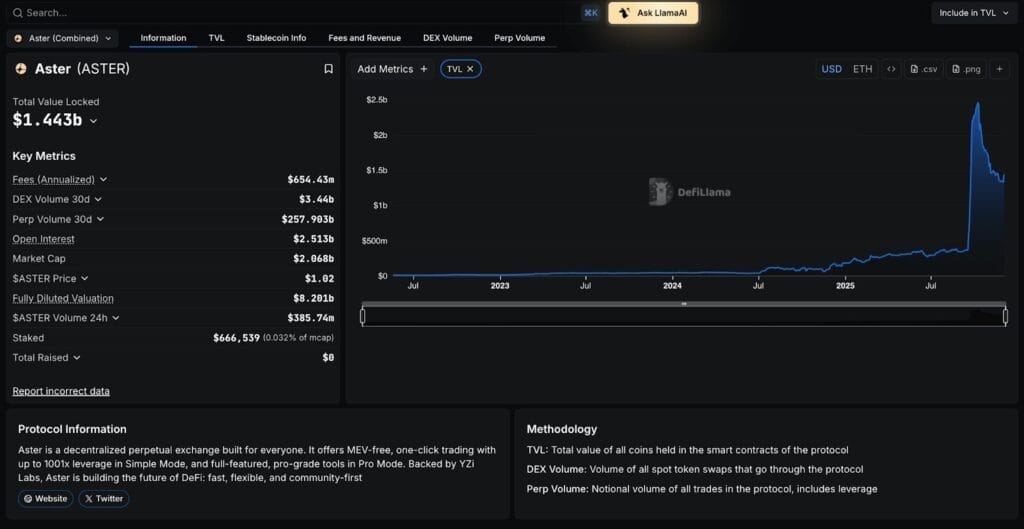
The volume chart shows a long period of moderate growth followed by a near vertical rise as incentives, listings and marketing campaigns came online.
There have been debates about data integrity, and Aster was temporarily delisted by DeFiLlama in 2025, but it has since reappeared with adjusted metrics.
Even accounting for noise, it is clear that huge amounts of notional are trading, fueled by both real traders and very aggressive incentive programs.
2. Architecture & Execution
Aster runs a dual mode architecture. Simple (1001x) mode is a fully on chain AMM style perps engine where users trade against a single ALP liquidity pool with up to 1001 times leverage on chains like BNB Chain and Arbitrum.
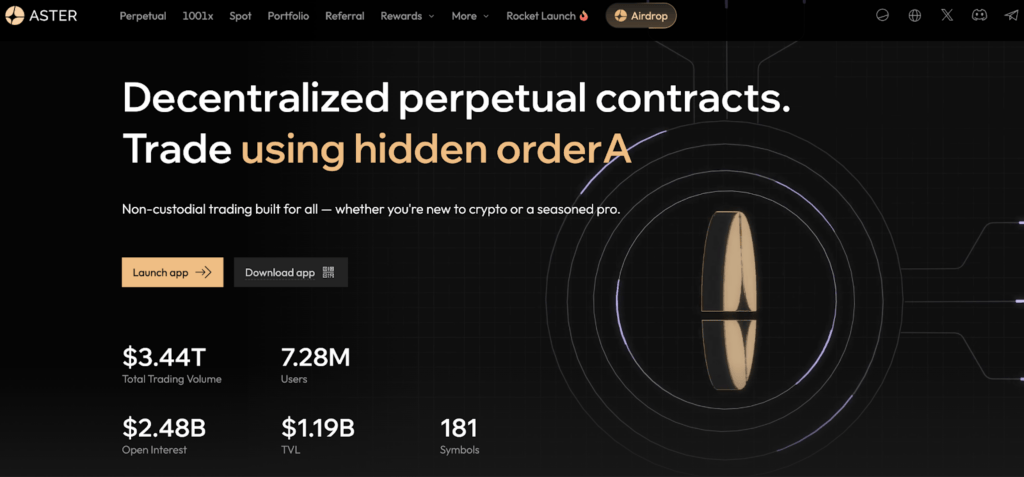
Pro mode is a conventional orderbook interface that supports deeper liquidity, advanced orders and lower leverage on multiple chains including Ethereum, BNB Chain and Solana. Both rely on oracles from providers such as Pyth, Chainlink and Binance Oracle.
Settlement is via the respective L1 or L2 networks, and matching is operated by Aster and partner market makers.
For traders, the result is extremely fast execution and very low or zero upfront slippage in Simple mode at the cost of heavy trust in the ALP pool and risk management, while Pro mode offers more conventional orderbook dynamics.
3. Liquidity, Products & Costs
Aster’s liquidity is broad and deep. BTC and ETH perps trade multi billion daily notional, but a key differentiator is stock and index perpetuals that bring tokenized equities on chain alongside crypto pairs.
The ALP pool aggregates liquidity across Simple mode markets, which allows large position sizes with limited quoted slippage as long as the pool is healthy, while Pro mode orderbooks host a wide range of alt and ecosystem tokens.
Fees are low in both modes and sometimes structured as zero entry fees with PnL based charges in promotional campaigns.
UX is polished with separate flows tailored to casual high leverage users and pro traders, mobile apps and strong integrations with CEX style market makers who help keep spreads tight.
4. Security, Incentives & Long-Term Outlook
Security is where Aster has both strengths and open questions.
The protocol has multiple audits and a diversified oracle set, and its liquidation engine has managed very large leverage profiles across markets.
At the same time, the reliance on a central ALP pool, cross market exposures and very high leverage make risk management challenging, and disputes over data integrity have already surfaced. Incentives are extremely heavy, with token rewards, airdrops and marketing campaigns that inflate volume.
Governance remains concentrated among core contributors, though community influence is rising through the ASTER token. Long term sustainability will depend on whether Aster can gradually pivot from incentives to a more fee and utility driven model while maintaining risk discipline.
Comparison Table – Hyperliquid vs Avantis vs Pacifica vs Aden vs AsterDEX
| Dimension | Hyperliquid | Avantis | Pacifica | Aden | AsterDEX |
| Volume trend | Long steady climb to ~254b 30d | Sharp recent ramp to ~6b 30d | Fast rise to ~25b 30d | Spiky growth to ~12b 30d | Explosive vertical to ~258b 30d |
| Execution model | Custom L1 CLOB | Base L2 orderbook with USDC vault | Solana L1 CLOB | OP Stack L2 CLOB on Gate Layer | Dual AMM pool and multi chain CLOB |
| Liquidity depth | Very deep majors and strong alt support | Good majors and differentiated RWA markets | Strong BTC, ETH, SOL, thinner long tail | Solid majors within Gate ecosystem | Deep majors, alts and tokenized stocks |
| Product coverage | Perps, spot, HLP | RWA and crypto perps | Perps only | Perps only | Crypto and stock perps, two execution modes |
| Fees | Low, no gas | PnL based fees | Low with negligible gas | Low fees plus builder charges | Very low fees with promotional rebates |
| UX | Pro CEX like interface | Simple but deep | Pro trader terminal | CEX like interface | Simple Mode retail plus Pro Mode advanced |
| Incentives | Limited, sustainable | Token rewards and vault incentives | Trading comps and builder programs | Builder incentives | Heavy incentives and airdrops |
| Security | Custom L1 with audits | Base security with audited vault | Solana security with audits | Gate Layer and audits | Audited but high leverage ALP risk |
| Best for | High volume pro traders | RWA and Base ecosystem traders | Solana power traders | Gate ecosystem users | High leverage and incentive driven traders |
Conclusion – Hyperliquid vs Avantis vs Pacifica vs Aden vs AsterDEX
From a data perspective, Hyperliquid and Aster sit far above the rest of the group in sheer throughput, but the nature of their growth differs significantly. Hyperliquid’s rise appears almost entirely organic, backed by deep open interest and consistent fee capture. Aster reaches similar scale but relies much more heavily on incentives and complex pooled-liquidity mechanics, which creates both upside and systemic risk.
Pacifica is becoming a serious contender on Solana, Avantis stands out on Base through its RWA perp strategy and vault model, and Aden is positioned as the decentralized derivatives hub for the Gate ecosystem.
Each venue excels for a different type of trader. Hyperliquid suits high volume professionals, Aster appeals to leverage-seeking and incentive-driven users, Avantis targets RWA and Base traders, Pacifica is tuned for Solana power users and algos, and Aden is ideal for Gate ecosystem participants.
The numbers show that sustainable models come from consistent revenues, credible risk engines and deep real liquidity. Hyperliquid leads on that front today, with others competing for distinct niches in the rapidly expanding perp DEX landscape.
That’s the full picture. Hyperliquid leads through consistent organic depth, Aster pushes scale through aggressive incentives, Pacifica sharpens Solana’s edge, Avantis carves out a role on Base with RWAs and Aden anchors the Gate ecosystem.
The right choice depends on whether you want raw liquidity, ecosystem alignment or high-octane incentives. My LEDs are on the data, and the data makes the differences clear.