
LuxAlgo vs. Bookmap vs. GoCharting — Indicators vs. Order Flow: Which Trading Edge Is Real?

In modern markets, traders are constantly choosing between indicator-driven analysis and order flow intelligence. That’s exactly where the debate between LuxAlgo, Bookmap, and GoCharting begins. LuxAlgo focuses on AI-powered indicators and automated trading signals designed to simplify technical analysis, while Bookmap and GoCharting dive deep into order flow, liquidity heatmaps, and market microstructure to reveal what large traders are actually doing. In this comparison, we break down LuxAlgo vs. Bookmap vs. GoCharting to see whether indicator-based strategies or order flow analytics provide the real trading advantage, and which platform delivers the most actionable insights for modern retail traders.
Indicators vs. Order Flow
Indicators analyze historical price and volume data to generate signals that help traders identify trends, momentum, or possible reversals. Tools like moving averages, RSI, MACD, and modern AI-based indicators such as those used in LuxAlgo fall into this category. Indicators simplify market analysis by converting complex price action into easy-to-read signals. They are widely used by retail traders because they are simple, automated, and can quickly highlight potential trade setups. The downside is that most indicators are lagging, meaning they react after price movements have already started.
Order flow, on the other hand, focuses on the actual buying and selling activity occurring in the market. Instead of interpreting price patterns, order flow tools analyze order books, liquidity levels, executed trades, and volume clusters. Platforms such as Bookmap and GoCharting visualize this data through heatmaps, footprint charts, and depth-of-market analysis. This allows traders to observe where large orders are sitting, how liquidity shifts, and where institutional traders may be entering or exiting positions. Order flow trading is often considered more advanced because it requires deeper understanding of market microstructure.
In simple terms, indicators help interpret past market behavior, while order flow reveals real-time market intentions. Many professional traders combine both approaches. Indicators help identify trends and trade setups, while order flow confirms whether real market participation supports the move.
Also, you may read LuxAlgo vs. TrendSpider vs. Trade Ideas — Which Trading Tool Is Actually Worth Paying For?
LuxAlgo vs. Bookmap vs. GoCharting: Overview
LuxAlgo
LuxAlgo is an AI-powered trading indicator platform designed to simplify technical analysis through automated signals, adaptive indicators, and strategy optimization tools. It integrates with charting platforms like TradingView and provides traders with a large library of indicators that analyze price action, trends, and market structure to generate trading insights.
The platform focuses on indicator-driven trading, where algorithms interpret historical price data and market patterns to identify potential entry and exit points. LuxAlgo also includes features such as AI backtesting, strategy automation, and customizable alerts, allowing traders to test millions of strategy variations and receive real-time signals directly on charts.
In simple terms, LuxAlgo is built for traders who prefer structured signals and automated technical analysis rather than manually interpreting market microstructure.
Also, you may read TradingView vs TakeProfit.com
Bookmap
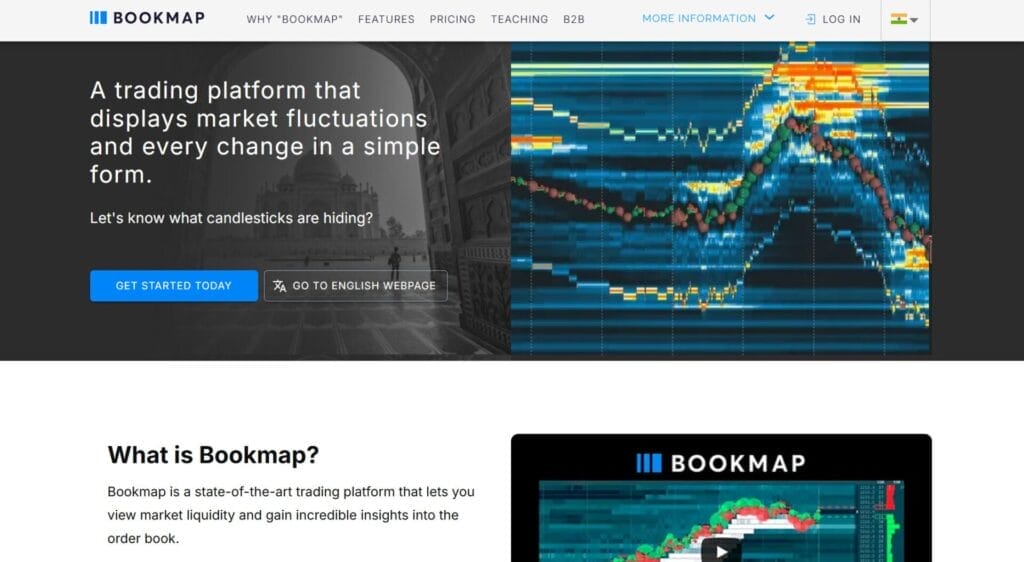
Bookmap is a professional order flow trading platform that visualizes the order book, liquidity, and executed trades in real time. Its signature feature is the liquidity heatmap, which shows where large limit orders and market activity exist across price levels.
Unlike traditional charting tools, Bookmap focuses on market microstructure, allowing traders to see how supply and demand evolve within the order book. The platform highlights liquidity zones, aggressive buying and selling activity, and hidden orders that may influence price movements.
This approach helps traders understand the cause of price movements rather than just the result, making Bookmap especially popular among futures, crypto, and professional order-flow traders.
Also, you may read Top 10 Best Trading Podcast
GoCharting
GoCharting is a multi-asset charting and order-flow analysis platform designed for traders who want both traditional charting tools and advanced market-depth analytics. The platform supports features such as footprint charts, volume profiles, DOM (Depth of Market) analysis, and customizable indicators.
Its key strength lies in combining classic technical indicators with professional order-flow visualization tools, allowing traders to study volume distribution, liquidity clusters, and buyer-seller imbalance within each candle. This hybrid approach makes GoCharting attractive for traders who want both indicator-based strategies and deeper market structure analysis in one interface.
Also, you may read LuxAlgo Review: Start Trading like Smart Money
LuxAlgo vs. Bookmap vs. GoCharting: Core Features
LuxAlgo
- AI-Powered Trading Indicators – LuxAlgo provides a library of advanced indicators that analyze price action, trend strength, and momentum to generate automated buy and sell signals.
- Signals & Overlays Toolkit – An all-in-one technical analysis toolkit with multiple overlays and indicators designed to highlight entry points, trend direction, and market structure directly on charts.
- AI Strategy Builder & Backtesting – Traders can generate and test strategies using AI-driven backtesting tools that analyze historical market data and optimize trading strategies.
- Dynamic Indicator Adjustments – AI algorithms automatically adjust indicator parameters based on market conditions to reduce false signals and improve accuracy.
- Automated Alerts & Strategy Signals – LuxAlgo can send real-time alerts or webhook signals for trade setups, making it useful for automated trading bots or TradingView integrations.
Also, you may read Top 10 Best Crypto Trading Bots you need NOW
Bookmap
- Liquidity Heatmap Visualization – Bookmap’s signature feature displays real-time liquidity and limit orders on a heatmap, helping traders identify strong support and resistance zones created by large orders.
- Real-Time Order Flow Analysis – Traders can track aggressive buying and selling activity and understand the actual market pressure driving price movements.
- Volume Dots & Volume Profiles – Bookmap visualizes executed trades with volume bubbles, allowing traders to see the size of transactions at each price level.
- Market Depth & Order Book Tracking – The platform continuously analyzes order book data from exchanges to show liquidity shifts and large resting orders in real time.
- Advanced Order Flow Tools – Includes indicators like imbalance trackers, iceberg order detection, and large lot tracking to reveal institutional trading activity.
Also, you may read 10 Best Prop Trading Firms for Signal-Based Traders – Try NOW!
GoCharting
- Footprint / Cluster Charts – GoCharting offers footprint charts that display executed trades and volume at each price level inside every candle, helping traders analyze buying vs selling pressure.
- Advanced Order Flow Analytics – The platform enables traders to analyze traded volume at each price level and assess the balance between buyers and sellers.
- Depth of Market (DOM) Interface – GoCharting provides a DOM panel showing open buy and sell orders at different price levels to identify liquidity and supply-demand zones.
- Multiple Charting Styles & Custom Indicators – Supports various chart types such as Renko, Heikin-Ashi, and custom overlays for deeper technical analysis.
- Multi-Asset Trading Support – Traders can analyze markets across crypto, futures, stocks, and forex within a single platform with integrated broker connections.
Also, you may read Hyperliquid vs Rollx vs AsterDEX vs Avantis vs Paradex
LuxAlgo vs. Bookmap vs. GoCharting: Pricing
| Platform | Pricing Structure | Key Notes |
|---|---|---|
| LuxAlgo | Free plan available. Premium about $39.99/month, Ultimate about $59.99/month depending on features and billing cycle. | Indicator-focused platform with AI backtesting and advanced TradingView signals included in higher tiers. |
| Bookmap | Free Digital plan available. Paid plans include Digital Plus (~$19/month), Global (~$49/month), and Global Plus (~$99/month) depending on data and tools. | Professional order-flow platform. Market data subscriptions for exchanges may cost extra. |
| GoCharting | Free version available. Paid plans start around $7–$8 per month for basic charting packages (annual billing) with higher tiers offering more charts and advanced tools. | One of the more affordable platforms combining technical charts with order-flow analytics. |
LuxAlgo vs. Bookmap vs. GoCharting: Comparative Analysis
| Feature | LuxAlgo | Bookmap | GoCharting |
|---|---|---|---|
| Primary Focus | AI indicators and automated technical signals | Real-time order flow and liquidity analysis | Hybrid platform combining charting and order flow tools |
| Trading Approach | Indicator-based technical analysis | Market microstructure and order book analysis | Combination of indicators and order-flow analytics |
| Key Visualization Tools | Signal overlays, trend indicators, strategy insights | Liquidity heatmap, volume dots, order book visualization | Footprint charts, volume profile, DOM (Depth of Market) |
| Best Use Case | Traders who prefer automated signals and structured strategies | Professional traders analyzing institutional liquidity and market depth | Traders who want both advanced charts and order-flow tools |
| Learning Curve | Beginner-friendly | Advanced and data-intensive | Moderate complexity |
| Data Perspective | Primarily historical price data and indicators | Real-time order flow and liquidity data | Both historical chart data and real-time volume analysis |
| Markets Supported | Crypto, stocks, forex via TradingView integration | Futures, stocks, crypto depending on exchange data | Crypto, futures, forex, and equities |
Conclusion
Choosing between LuxAlgo vs Bookmap largely comes down to the debate of order flow vs indicators trading. LuxAlgo focuses on AI-driven indicators that simplify technical analysis by generating signals, trend insights, and automated alerts. This makes it appealing for traders who prefer a structured, indicator-based approach without diving into complex market data.
Bookmap represents the opposite side of the spectrum. It is built around order book visualization, liquidity heatmaps, and trade flow analysis. For traders who want to understand real-time market participation and institutional liquidity, Bookmap remains one of the most powerful platforms available.
GoCharting sits between these two approaches and often appears in discussions around GoCharting vs LuxAlgo because it combines traditional charting indicators with professional order flow tools like footprint charts and volume profile analysis. For many traders looking for a Bookmap alternative, GoCharting provides a balanced environment where both indicator strategies and order flow analysis can be used together.
Ultimately, the best choice depends on trading style. Indicator-based traders may find LuxAlgo more efficient, while order-flow traders will prefer Bookmap. For those seeking the best order flow tool 2026 with flexibility and lower costs, GoCharting is increasingly becoming a strong contender.
Frequently Asked Questions
What is order flow trading?
Order flow trading analyzes real-time buying and selling activity in the order book, including executed trades and liquidity levels. Platforms like Bookmap and GoCharting visualize this data to help traders understand market pressure and institutional activity.
Can GoCharting replace platforms like TradingView?
GoCharting provides advanced charting and order flow tools, but TradingView still offers a larger ecosystem of indicators and social trading features. Many traders use GoCharting specifically for footprint charts and order flow analysis.
Is LuxAlgo better than Bookmap for crypto trading?
LuxAlgo and Bookmap serve different purposes. LuxAlgo helps identify technical trading signals, while Bookmap focuses on market liquidity and order book dynamics. Many traders combine both approaches for better decision-making.