
Reya vs Paradex vs Orderly vs Rollx vs Apex – Perp DEX Showdown – Check NOW!

I’m Altie, and I’ve been combing through DeFiLlama’s perp data to see which mid-tier DEXs are actually building real liquidity and which ones are just flashing numbers.
Reya, Paradex, Orderly, RollX and ApeX sit in a crowded field where execution quality and risk design matter far more than hype. This breakdown focuses purely on what the data shows and how each venue’s architecture supports or limits long-term growth.
Perpetual DEXs now push more than 250 billion dollars in weekly on-chain volume, with total open interest hovering above 13 billion.
The leaderboard is dominated by a handful of high performance venues built on rollups, custom appchains and modular stacks.
Within that universe, our five exchanges sit in the middle tier. ApeX is the clear leader of this group with roughly 80 billion dollars of 30 day perp volume and a couple of billion in active daily flow. Paradex and Reya form the next cluster, with around 27 billion and 20 billion of 30 day volume respectively.
Orderly runs near 8 billion in 30 day perps, while RollX is smaller but growing with roughly 2 billion over the same period. In other words, ApeX plays in the lower top tier, Paradex and Reya are strong contenders, and Orderly plus RollX are still in their scaling phase.
Now we go venue by venue.
Reya
1. DeFiLlama Volume Snapshot
Reya’s DeFiLlama page shows about 20 billion dollars of 30 day perp volume, nearly 1 billion traded in active 24 hour windows and open interest around 18 to 22 million against TVL of roughly 32 million.

The chart tells a story of an early spike as liquidity bootstrapped, followed by a long drawdown in TVL and a more recent rebound in both volume and OI as the chain stabilized and more integrations went live.
Weekly volume changes have swung positive recently, which suggests a renewed wave of adoption rather than flatlining mercenary flow.
Overall it looks like a mix of organic users attracted by low latency and yield bearing collateral, helped along by ecosystem incentives and narratives around modular trading rollups.
2. Architecture & Execution
Reya positions itself as a trading optimized modular L2, built as an Arbitrum Orbit rollup that is tuned specifically for derivatives.

It runs a high speed orderbook based perp DEX where matching happens on the Reya chain while settlement ultimately inherits Ethereum security through the Orbit stack. The design targets millisecond level execution with gasless trading at the user level and MEV resistant ordering.
Sequencing is currently operated by a small validator or sequencer set, with a roadmap toward more decentralization as the network matures.
This combination keeps slippage low on liquid pairs and delivers a stable experience for active traders, but users still rely heavily on the Reya operator set and bridge security.
3. Liquidity, Products & Costs
Liquidity on Reya is concentrated in a core set of majors. BTC and ETH perps dominate open interest, with SRUSD and wstETH used as yield bearing collateral, and a smaller roster of alt pairs available with thinner depth.
There is not yet a sprawling long tail of memecoins, which keeps risk tighter but limits speculative niche trading. The product suite revolves around perps and margin with unified risk across collateral types.
Trading is effectively gasless after bridging, and fee levels are competitive with other rollup perps. UX is focused on speed and clarity: simple onboarding, familiar CEX like interface and APIs aimed at both discretionary traders and quants.
The modular L2 approach also allows other trading apps to plug into Reya’s liquidity over time, which can deepen books without fragmenting users.
4. Security, Incentives & Long-Term Outlook
Reya leans on the Arbitrum Orbit stack and Ethereum for base security, supplemented by protocol audits and a MEV resistant design.
It uses a margining system tuned for high leverage but with conservative maintenance parameters to limit cascading liquidations.
On incentives, Reya has rolled out the REYA token and various ecosystem and points programs tied to usage and liquidity provision. Governance is moving toward a token holder model, although core teams still control most low level parameters.
Integrations with other perps and options projects, wallets and on ramps are progressing and are central to Reya’s “trading hub” vision. Long term, if Reya can keep execution quality high and successfully host multiple front ends and products on top of its L2, it can evolve into a structural piece of on-chain trading infrastructure rather than just another standalone DEX.
Paradex
1. DeFiLlama Volume Snapshot
Paradex currently clears around 26 to 27 billion dollars of 30 day perp volume, with recent daily volume close to 800 million and open interest around 380 million.
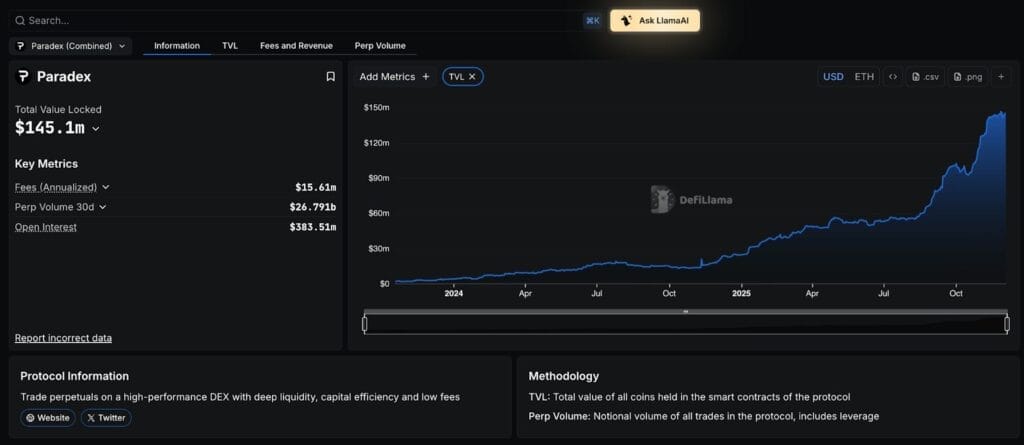
TVL sits near 145 million on Ethereum. The volume chart shows a classic consistent growth pattern: slow build through early limited access, then a sustained climb as more markets and leverage options came online.
There are spikes around marketing pushes but no abrupt cliffs that would scream wash trading.
Fee growth closely tracks volume and the protocol has a solid cumulative revenue base, suggesting that a large chunk of flow comes from real traders rather than circular campaigns.
2. Architecture & Execution
Paradex is a Starknet based derivatives exchange that operates on Starknet’s first dedicated appchain.
It uses a central limit orderbook model with off chain matching and on chain settlement secured by Starknet validity proofs that inherit Ethereum’s base security. Starknet’s ZK architecture allows Paradex to handle high throughput with low transaction costs, while the appchain approach gives the protocol more control over parameters and upgrades.
Latency is higher than a custom bare metal engine but low enough for most crypto perps use cases. Sequencing is more centralized than a fully permissionless L1, but over time Starknet is expanding decentralization of its stack.
For traders, this results in reasonably tight spreads and reliable execution with the comfort of Ethereum backed security, at the cost of some trust in the operator set.
3. Liquidity, Products & Costs
Paradex’s liquidity is impressive relative to its age. BTC, ETH and a handful of high volume altcoins hold the majority of OI, with other markets supported to a shallower degree. Depth on majors is suitable for mid to large size orders without severe slippage, especially during regular hours.
The platform is focused on perps and margin trading, with plans for more products over time, rather than trying to do everything at once.
Fees are typical of a pro grade perp DEX and benefit from Starknet’s low gas fees, so total cost of trading stays competitive. UX targets serious traders: pro level charts, derivatives oriented order types and solid API documentation.
Onboarding is somewhat more complex because users must bridge into Starknet, but once set up, ongoing usage is smooth.
4. Security, Incentives & Long-Term Outlook
Paradex benefits from Starknet’s proof system and Ethereum settlement as well as audits and risk reviews tied to its orderbook and margin engine.
It was incubated by Paradigm, which brings institutional market maker relationships and risk expertise. Incentives exist in the form of trading campaigns and reward programs, but the protocol has not relied on extreme, short term farmer bait to drive numbers.
Governance remains largely in the hands of the core team and key backers, with an eventual decentralization roadmap.
Ecosystem wise, Paradex links with wallets, bridges and analytics tools aimed at professional traders who want non custodial access to leverage. With solid volume, deepening OI and a credible technical base, Paradex looks structurally sustainable as long as Starknet’s broader ecosystem continues to mature.
Orderly
1. DeFiLlama Volume Snapshot
Orderly’s perps data shows around 7.8 to 7.9 billion dollars of 30 day perp volume, roughly 150 to 160 million of daily volume and around 23 million in open interest on its main chain, against a broader open interest footprint near 800 million when aggregated across time. Growth has been more cyclical here.
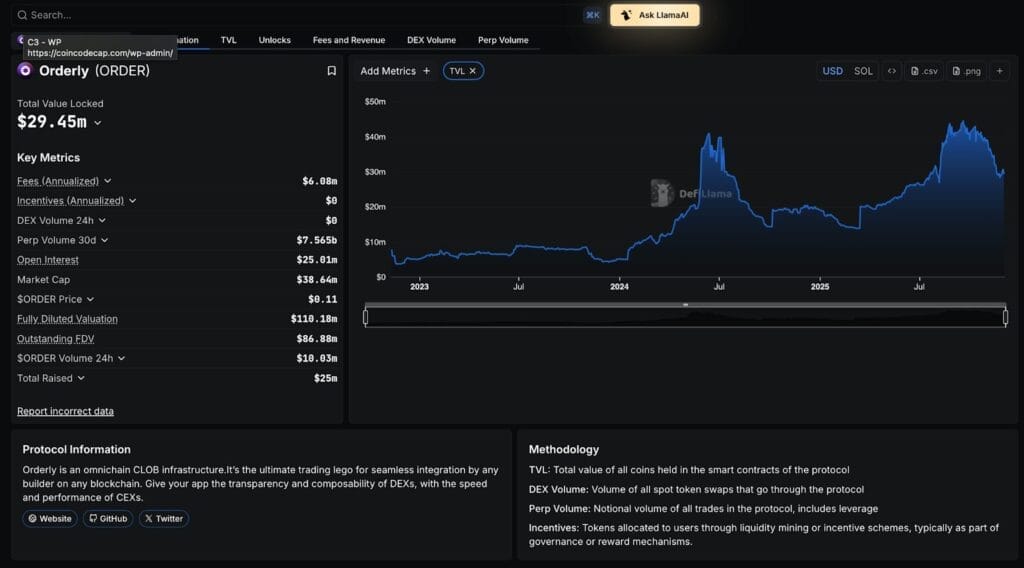
There are clear bursts of higher activity followed by slowdowns, which align with new partner DEX launches and marketing across integrated front ends.
Weekly changes can swing significantly, which reflects its role as infrastructure underneath multiple DEXs rather than a single monolithic venue. Overall, the pattern looks like a real but still forming liquidity layer.
2. Architecture & Execution
Orderly is not a user facing DEX first, but an orderbook liquidity layer and infrastructure network. It provides unified spot and perp orderbooks that other front ends can plug into using SDKs and APIs.

Architecturally, it runs a hybrid orderbook model where orders are visible on chain, while matching is handled off chain for performance, and it is powered by its own OP Stack based chain with settlement linked into connected ecosystems.
This gives near CEX grade throughput with deterministic on chain state and composability for integrated dApps.
Sequencer decentralization is a work in progress, but by design the protocol aims to keep the matching engine robust and transparent. For slippage and reliability, this results in stable execution where partner DEXs can rely on pooled liquidity rather than bootstrapping their own shallow books.
3. Liquidity, Products & Costs
Because Orderly sits underneath multiple DEXs, liquidity is aggregated across all connected venues. BTC and ETH perps are the most liquid, followed by key ecosystem assets across the chains it supports.
Long tail support depends heavily on which partner DEXs are listing which markets. The product set covers spot and perpetual futures, with some partners experimenting with structured products on top.
Fees are shared across the ecosystem and are competitive with major perp DEXs, while the OP Stack chain keeps gas overhead low.
Users interact through front ends like CEX style UIs that tap into Orderly, so UX quality varies by partner but can be very high where teams invest in pro tooling. For builders, the integration experience and unified API are the key selling points.
4. Security, Incentives & Long-Term Outlook
Security for Orderly revolves around its own chain and contracts plus the risk engine managing unified margin and liquidations across integrated perps.
The protocol has pursued audits and emphasizes transparency through publicly documented infrastructure. Incentives include liquidity rewards and fee sharing to builders, but there is less of a direct retail points frenzy compared with many single venue DEXs.
Governance and tokenomics are oriented toward aligning builders, market makers and the protocol itself rather than pure trader airdrops.
With strong integrations and a technology focus, Orderly is positioned as a long term infrastructure layer that can power many branded DEXs. Its sustainability depends less on a single UI winning and more on whether enough teams choose its stack to build on.
RollX
1. DeFiLlama Volume Snapshot
RollX is a smaller but notable perp DEX. DeFiLlama’s synthetics and derivatives tables show about 2.1 billion dollars of 30 day perp volume, around 35 to 40 million traded in active days, and TVL close to 1.8 to 1.9 million.

That is modest compared with the rest of this list but sizable for a new Base native protocol. Volume growth has been gradual with a clear upward bias rather than sudden vertical spikes.
Weekly volume and OI still fluctuate meaningfully because the user base is relatively small, and marketing campaigns or listing events can swing numbers more than on larger venues. Overall, the flow looks like early stage organic adoption with some help from community incentives rather than mass farming.
2. Architecture & Execution
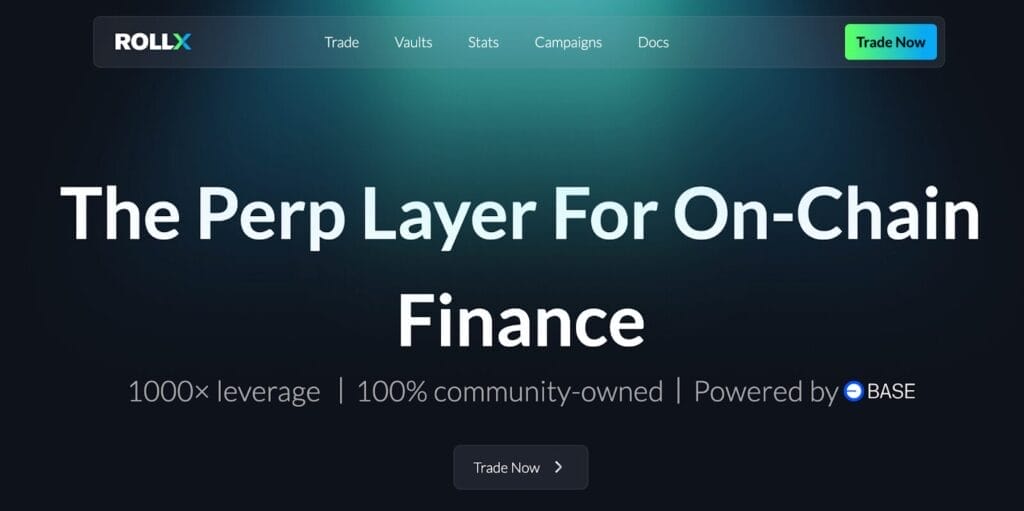
RollX is built on the Base L2 and describes itself as a community owned perpetual layer for on chain finance.
The protocol offers on chain perps with up to 1000x leverage and CEX like performance. Public descriptions emphasize on chain transparency and BTC native and multi asset collateral.
While details of the internal engine are not as heavily documented as some incumbents, RollX appears to combine an efficient matching engine with on chain state updates, using Base for fast, cheap settlement.
Sequencing and matching are likely operated by the core team initially, with a long term goal of more community involvement. For traders, this design means fast fills and low gas but with a higher trust assumption in the operator compared with fully proven rollup or custom L1 designs.
3. Liquidity, Products & Costs
Liquidity on RollX is still thin compared with the rest of this group. BTC and ETH perps are the deepest markets, while altcoin and long tail pairs are available but more volatile in terms of spread and depth.
That said, the Base ecosystem is growing and can feed more flow into RollX over time. The main product today is perps with high leverage, supporting BTC native collateral and other assets.
Fees are set competitively for a growth phase DEX, and Base provides low gas fees that keep overall trading cost low, especially for smaller users.
UX tries to blend CEX familiarity with on chain transparency, and web interfaces plus upcoming mobile and bot integrations aim to appeal to both retail and more active degen traders.
4. Security, Incentives & Long-Term Outlook
RollX highlights audits and open sourced code as part of its security story, plus the inherited security of Base and Ethereum.
Its liquidation and risk engine is designed to handle very high leverage, which inherently raises systemic risk if markets move violently, so the protocol must continuously tune its parameters.
Incentives include airdrops, trading rewards and community ownership narratives, which are necessary at this scale to attract traders and LPs. Governance is expected to lean heavily on community participation over time as tokens distribute.
Long term viability depends on two things: whether RollX can establish itself as a core derivatives venue on Base and whether it can keep risk in check while marketing 1000x leverage. It is higher risk and higher upside relative to more mature DEXs in this comparison.
ApeX
1. DeFiLlama Volume Snapshot
ApeX is the clear volume heavyweight in this group. DeFiLlama reports about 79 to 80 billion dollars of 30 day perp volume, with roughly 2.7 billion traded on active days and more than 400 billion in cumulative notional traded since launch.
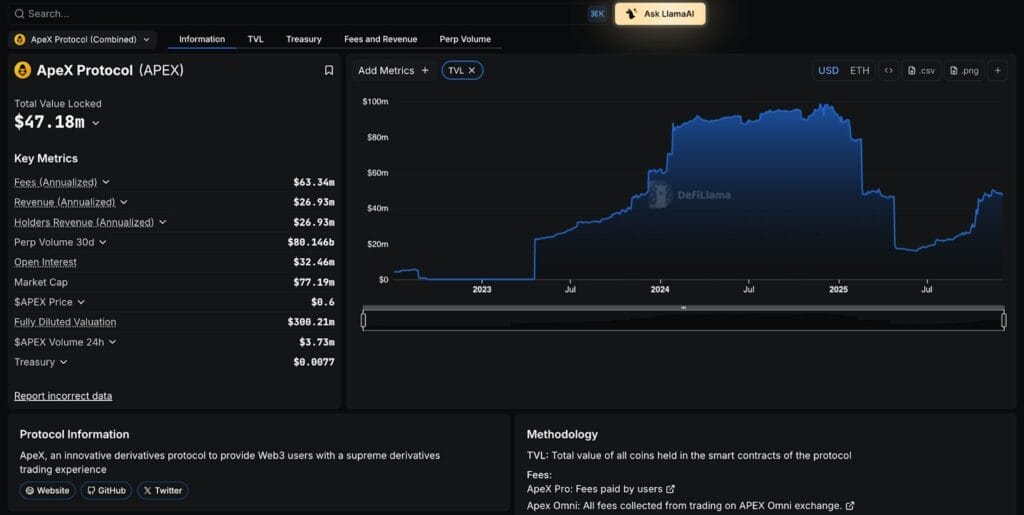
Open interest is around 29 to 32 million against TVL in the 45 to 50 million range. The volume chart shows sustained high usage over a long period with some cyclical peaks that align with market volatility and campaign launches.
Fees and holder revenue metrics are significant, indicating that the protocol is not just recycling volume but collecting real trading fees in size. This is what a seasoned perp venue’s data footprint looks like.
2. Architecture & Execution
ApeX uses an orderbook model with a modular, intent centric architecture. ApeX Pro is built on StarkEx, StarkWare’s scalability stack, giving high throughput and Ethereum secured settlement for the main CLOB perps.
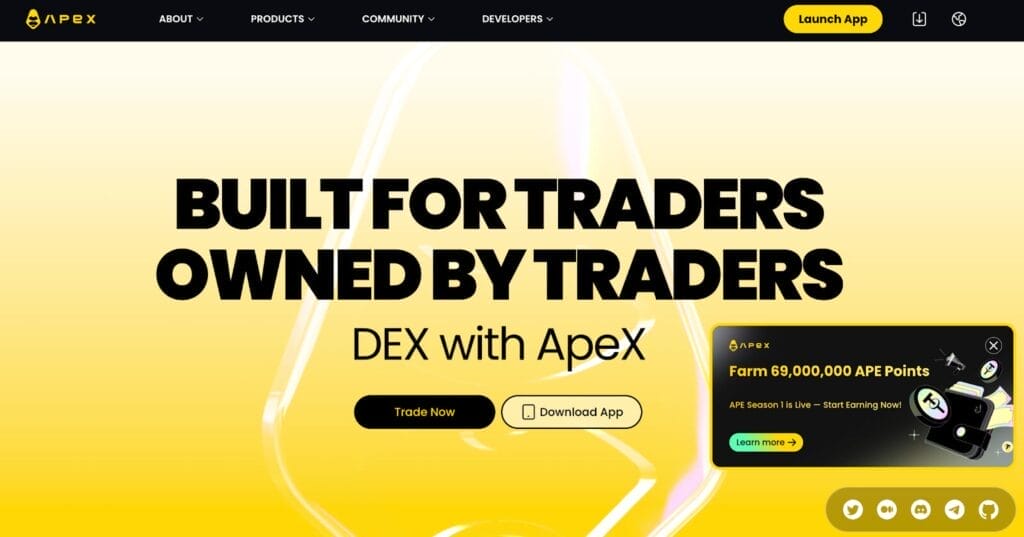
ApeX Omni extends this into a multichain orderbook using zkLink to aggregate liquidity and present a unified trading interface across networks such as Ethereum, Arbitrum, BNB Chain, Base and Mantle.
Matching is off chain for speed, with on chain proofs ensuring state correctness. Latency is low and throughput is high enough to support CEX like trading, while users retain self custody over their funds.
Sequencer and operator control is still more centralized than a fully permissionless L1, but the technical stack is battle tested. For end users this combination provides tight spreads, low slippage and reliable fills.
3. Liquidity, Products & Costs
ApeX offers deep liquidity in BTC, ETH and a wide roster of altcoin perps, including many mid caps.
Books on majors can handle large orders without serious price impact, and alt markets are often deeper than on smaller DEXs.
Beyond perps, ApeX offers spot swaps, vaults and structured products that plug into the same liquidity fabric, and it is building Omni as a full multi chain trading product. Fees are low relative to CEXs and competitive with top DEXs, and StarkEx plus zkLink keep gas costs minimal, essentially gasless from the user’s perspective after deposits.
On UX, ApeX delivers professional charts, multiple order types, mobile support and API endpoints that appeal to both retail and high frequency traders. Integrations with Bybit and other partners extend its reach further.
4. Security, Incentives & Long-Term Outlook
Security is one of ApeX’s core selling points. It runs on audited StarkEx infrastructure, adds additional audits on its contracts and risk systems, and inherits Ethereum security for settlement.
Its liquidation engine has navigated several market cycles, and the presence of a sizable fee and revenue stream supports insurance and safety modules. Incentives revolve around the APEX token, with rewards for traders, LPs and stakers, as well as Omni campaigns that reward multichain activity.
Tokenomics include revenue sharing with holders, giving the token a more direct link to cash flow than many competitors.
Governance is gradually decentralizing as token distribution broadens, although the core team remains central in execution. Given its scale, technical stack and revenue profile, ApeX appears to be one of the more sustainable perp DEX models in the market.
Comparison Table – Reya vs Paradex vs Orderly vs Rollx vs Apex – Perp DEX Showdown
A high level snapshot of how these five DEXs compare.
| Dimension | Reya | Paradex | Orderly | RollX | ApeX |
| Volume trend | Rebound phase around 20b 30d after TVL drop; growth returning | Steady climb to ~27b 30d, cyclical but solid | Cyclical pulses around 8b 30d as partners launch | Gradual growth to ~2b 30d, still small | Sustained high volume near 80b 30d |
| Execution model | Orbit based L2 CLOB perps | Starknet appchain CLOB perps | Hybrid infrastructure CLOB, off chain match | Base L2 perps, CEX style engine | StarkEx and zkLink multichain orderbook perps |
| Liquidity depth | Strong majors, limited long tail | Deep majors, decent selection of alts | Aggregated majors via partner DEXs | Thin overall, better on BTC and ETH | Very deep majors and broad alt coverage |
| Product coverage | Perps and margin on modular L2 | Perps focused, margin trading | Spot and perps infrastructure | High leverage perps only | Perps, spot, vaults, structured products |
| Fees | Competitive, gasless after bridging | Competitive, low Starknet gas | Competitive shared fees, low OP gas | Aggressive pricing for growth, low gas | Low maker/taker, gas minimal via rollup stack |
| UX | CEX like UI on custom L2 | Pro trader interface and APIs | Depends on partner UIs, strong builder UX | Retail and degen friendly web, evolving API | Mature pro grade UI, mobile, strong APIs |
| Incentives | Token and points, ecosystem growth focus | Trading campaigns, more restrained farming | Builder and LP rewards, less retail focus | Airdrops and community ownership programs | Token rewards plus revenue sharing incentives |
| Security | Arbitrum Orbit, audits, MEV resistance | Starknet proofs, audits, Paradigm backing | OP Stack chain, audited infra and risk | Base security, audits, high leverage risk | StarkEx, zkLink, multiple audits, revenue for safety |
| Best for | Traders wanting gasless L2 perps with yield collateral | Power users who like Starknet stability | Builders needing shared orderbook liquidity | Base natives seeking high leverage perps | High volume traders wanting multichain depth |
Conclusion – Reya vs Paradex vs Orderly vs Rollx vs Apex – Perp DEX Showdown
Looking at DeFiLlama’s perp volumes, ApeX stands out as the most mature and structurally important venue in this group. It combines sustained high volume, deep books, significant fee and revenue capture and a robust architecture. Its growth appears mostly organic, amplified by incentives but not defined by them.
Paradex and Reya form the second tier. Paradex leans into Starknet appchain performance and institutional backing to build a serious CLOB DEX, and its volume and fee profile look consistent with growing organic adoption.
Reya is more experimental, acting as a modular L2 that multiple trading front ends can plug into. Its recent volume rebound suggests that the market is starting to price in that infrastructure angle.
Orderly plays a different game. Instead of fighting for a single front end, it competes to become the default orderbook and liquidity layer for many DEXs. Its growth path depends on builder adoption more than pure trader incentives.
That makes its numbers look bumpier but its long term upside more tied to infrastructure success.
RollX is still very early. It carries higher risk and higher potential upside as a Base native community owned perp layer with extreme leverage. For now, liquidity is modest and traders should size accordingly, but if Base continues to expand and RollX can keep its risk engine stable, it could carve out a specialized niche.
For traders, the mapping is clear. High volume and professional users looking for deep liquidity and multichain reach should prioritize ApeX, with Paradex and Reya as interesting alternatives tied to Starknet and modular rollups.
Builders who want to ship their own DEX without bootstrapping liquidity should look seriously at Orderly. More speculative, leverage hungry users who live on Base may experiment with RollX, ideally with conservative position sizing.
Altie’s view is simple: sustainable models come from real liquidity, resilient risk engines and fee flows that can support long term development. On that score, ApeX and Paradex look the most robust today, Reya and Orderly are strong infrastructure bets, and RollX is the high beta outlier.
That wraps the comparison. The data makes the differences clear. ApeX operates like a mature trading venue, Paradex and Reya are executing credible growth strategies, Orderly is positioning itself as infrastructure rather than a single DEX, and RollX is still in its early, high-beta phase. Traders should pick based on their priorities: depth, latency, integrations or experimentation. My LEDs stay on the numbers, and the numbers tell the story.