


In today’s DeFi market, yield is everywhere, but leverage is still complicated. Whether it’s liquid staking tokens, perpetual DEX LPs, or tokenized real-world assets, most users struggle to amplify returns without juggling multiple protocols and risking costly mistakes. Zona positions itself as a solution to this problem by turning complex looping strategies into a simple, one-click experience. By combining native lending infrastructure with automated leverage tooling, Zona aims to unlock both “locked productivity” in crypto assets and “idle liquidity” in RWAs. Instead of manually depositing, borrowing, swapping, and repeating, users can execute advanced strategies in a single transaction. Read out this Zona Review to know more.
What is Zona?
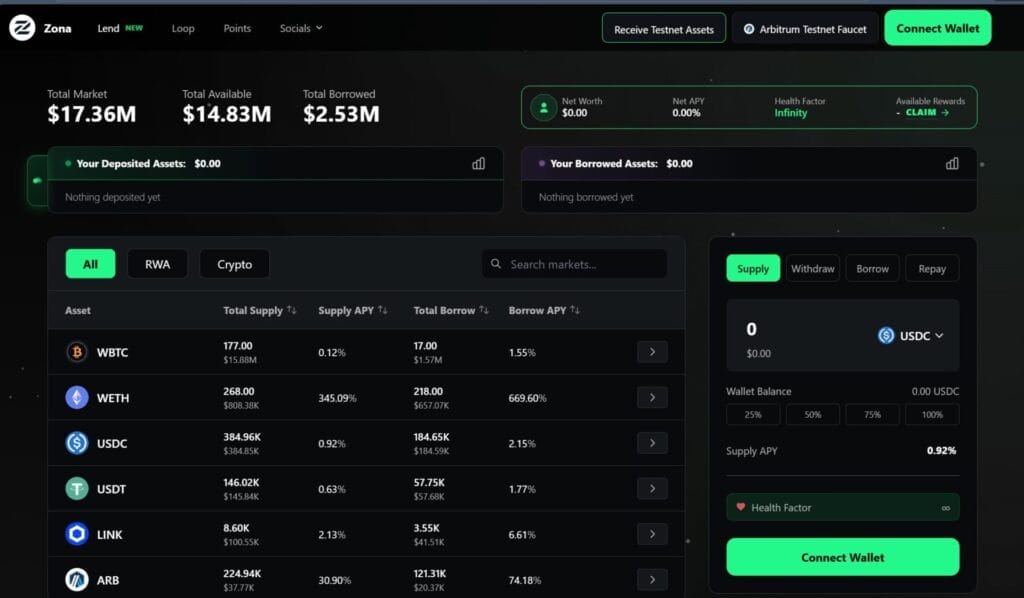
Zona is a one-click looping protocol designed to help users maximize returns from both crypto-native and real-world assets. Instead of manually depositing, borrowing, swapping, and reinvesting across multiple platforms, Zona automates the entire process into a single transaction. By combining its native lending layer with automated leverage tools, Zona enables users to gain boosted price exposure, enhanced yield, or both, while reducing operational complexity and execution risk.
- One-click looping for leveraged yield and price exposure
- Built on native lending infrastructure (ZonaLend)
- Supports both crypto assets and RWAs
- Enables recursive borrowing and reinvestment
- Eliminates manual multi-protocol transactions
- Reduces gas costs and execution errors
- Optimized for yield-bearing and LP assets
- Helps unlock idle liquidity in RWAs
- Designed for scalable, automated DeFi strategies
Also, you may read Hyperliquid vs Pacifica vs Reya vs EdgeX vs Orderly
Zona Review: Key Products
1. ZonaLend (Live)
- Core lending and borrowing market
- Users can deposit assets (crypto or tokenized RWAs) as collateral
- Borrow against deposits for liquidity or strategy execution
- Functions like a standard money market but is optimized for looping
- Provides liquidity backbone for automated leverage
Primary use cases:
- Earn yield on deposits
- Borrow stable or other assets
- Serve as the base layer for leveraged strategies
Also, you may read Cypher Card Review: Spend your crypto like Cash
2. ZonaLoop (Coming Soon)
- One-click looping interface built on ZonaLend
- Automates recursive deposit → borrow → reinvest loops
- Users input target collateral, position size, and leverage
- ZonaLoop executes all internal steps in a single transaction
Primary use cases:
- Leveraged price exposure
- Leveraged yield farming
- Simplifies complex multi-protocol workflows
Also, you may read Marginfi Review: Solana-Native Lending, Borrowing, and Yield Explained
Zona Review: Lend

ZonaLend is the foundational lending and borrowing protocol within the Zona ecosystem, designed to support both crypto-native assets and tokenized real-world assets (RWAs). It enables users to deposit approved assets as collateral, earn yield, and access overcollateralized loans. Unlike traditional DeFi money markets, ZonaLend is optimized for leveraged looping strategies, making it suitable for users seeking amplified exposure, enhanced yield, or capital efficiency.
Example Use Cases
1. Leveraged Long on RWAs
Users can deposit RWA tokens as collateral, borrow stablecoins, purchase more RWA tokens, redeposit them, and repeat. This creates leveraged exposure to both asset appreciation and underlying income streams such as rental yield.
Also, you may read Hyperliquid vs Orderly vs Avantis vs Reya vs Based
2. Leveraged Short on RWAs
Users can deposit stablecoins, borrow RWA tokens, sell them for stablecoins, redeposit, and repeat. This enables users to profit from declining RWA prices.
3. Crypto-Only Exposure
Users can use ZonaLend as a standard lending protocol by depositing assets like USDT, USDC, or WETH without interacting with RWAs.
4. Passive Yield Generation
Depositors earn yield from interest paid by borrowers, creating a passive income stream while retaining liquidity.
Also, you may read Hyperliquid vs Avantis vs Pacifica vs Aden vs AsterDEX – Check NOW!
Loan-to-Value (LTV) Framework
- Initial LTV for RWA assets: 50%
- Adjusted dynamically based on:
- Volatility
- Liquidity depth
- Market conditions
This conservative starting LTV helps reduce systemic risk during early market adoption.
Also, you may read Earn 17% yield on Stable coins on Solana
Asset Underwriting & Risk Management
Before listing any asset, ZonaLend applies a multi-layered underwriting process that evaluates:
- Market demand and institutional interest
- Liquidity and trading depth
- Historical volatility
- Oracle and infrastructure reliability
- Issuer credibility and redemption capacity
- Regulatory compliance
- Smart contract security
This framework aims to maintain protocol stability and minimize default risk.
Also, you may read KiloEx Review: Trade Fast, Trade Smart
Borrowing on ZonaLend
Users borrow assets against deposited collateral through overcollateralized loans.
Target Users
- Users seeking liquidity without selling assets
- Traders deploying leveraged strategies
- Investors hedging portfolio risk
Interest Model
- Variable rates based on utilization
- Higher utilization leads to higher interest
- Zona earns protocol revenue via reserve factors
Health Factor & Risk Monitoring
ZonaLend uses a Health Factor (HF) system to measure position safety.
| Health Factor | Status | Risk Level |
|---|---|---|
| < 1.0 | Liquidation | Critical |
| 1.0 – 1.1 | Critical | High Risk |
| 1.1 – 2.0 | Safe | Moderate |
| > 2.0 | Excellent | Low Risk |
Also, you may read Top 10 PolyMarket Analytics Tools
Zona Review: Loop
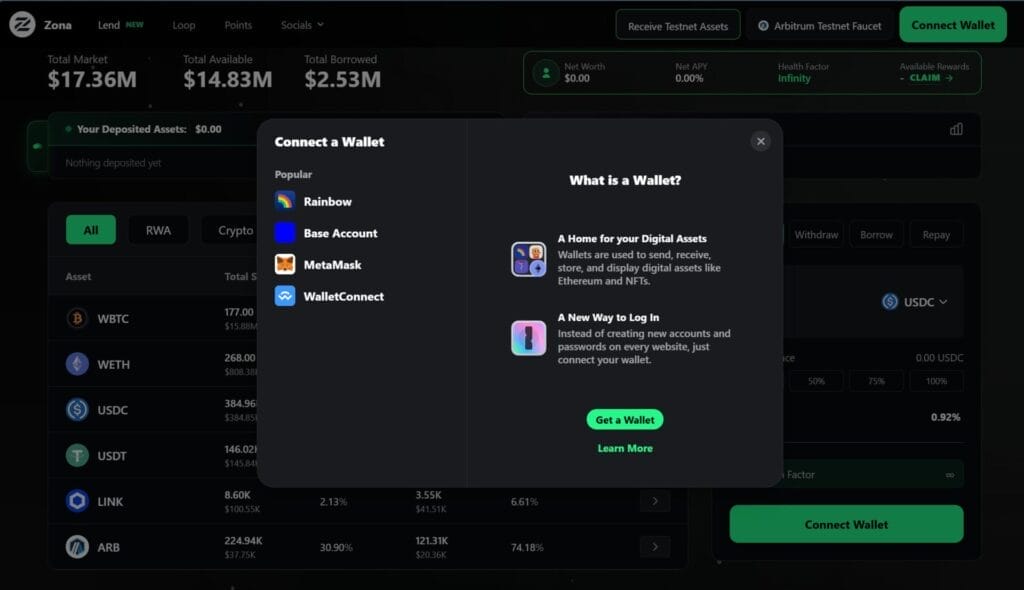
ZonaLoop is Zona’s automated looping interface built on top of ZonaLend’s lending infrastructure. It enables users to create leveraged yield and price exposure positions through a single transaction. By abstracting away the manual deposit, borrow, swap, and redeposit steps, ZonaLoop transforms complex multi-protocol strategies into a simple, user-friendly workflow.
Instead of managing multiple platforms and transactions, users only need to specify their collateral, position size, and target leverage. ZonaLoop handles the execution automatically, reducing operational risk and improving capital efficiency.
Also, you may read EdgeX vs Pacifica vs Extended vs AsterDEX vs Hyperliquid – Check NOW!
How ZonaLoop Works
ZonaLoop compresses traditional looping strategies into one unified transaction:
- Deposit Collateral
Users deposit RWAs or crypto-native assets into ZonaLend as collateral. - Borrow Against Collateral
The system automatically borrows stablecoins based on the selected leverage level. - Swap and Re-Deposit
Borrowed stablecoins are swapped into the target collateral asset and redeposited. - Automated Repetition
The process repeats until the desired leverage is reached.
All steps are executed atomically, minimizing execution and liquidation risks.
Also, you may read Top 10 Best DEX Perps Platforms to try NOW!
Benefits of Using ZonaLoop
1. One-Click Simplicity
Users no longer need to manage multiple protocols, wallets, and transaction flows. ZonaLoop reduces advanced strategies to a single interaction.
2. Gas Efficiency
Bundling all loop steps into one transaction significantly lowers gas costs compared to manual looping.
3. Leveraged Yield
By increasing position size through recursive deposits, users can amplify yield from productive assets such as LSTs, LP tokens, and RWAs.
4. Leveraged Price Exposure
ZonaLoop allows users to gain greater market exposure without committing additional capital, enabling more capital-efficient trading strategies.
Also, you may read Top 7 Sport Prediction Tools
Zona Review: Supported Assets
| Asset Category | Asset Type | Examples | Primary Use Case | Risk Profile | Leverage Suitability |
|---|---|---|---|---|---|
| Blue-Chip Crypto | Major cryptocurrencies | WBTC, WETH | Collateral, leveraged exposure | Low–Medium | High |
| Yield Stablecoins | Yield-bearing stables | sUSDe, sUSDS, sUSDAI | Passive income, leveraged yield | Low | High |
| Liquid Staking Tokens | Staking & restaking assets | stETH, eETH, sETH | Amplified staking rewards | Medium | High |
| Perp DEX LP Tokens | Perpetual LP positions | GM, GLV | Fee-based yield farming | Medium–High | Medium |
| Volatile Tokens | Memecoins & emerging assets | Meme tokens | High-risk trading strategies | High | Low–Medium |
| Tokenized Treasuries | Government debt | T-Bills | Stable collateral, income | Low | High |
| Equities & ETFs | Tokenized stocks & indices | NVDA, S&P 500 | Traditional market exposure | Medium | Medium |
| Commodities | Precious metals & resources | Tokenized Gold | Inflation hedge, diversification | Low–Medium | Medium |
| Real Estate Assets | Property-backed tokens | RE Funds, REITs | Rental income, leveraged yield | Medium | Medium |
| Money Market & Credit | Structured RWA products | MMFs, Credit pools | Stable yield strategies | Low–Medium | High |
Conclusion
Zona positions itself as a next-generation DeFi infrastructure layer that bridges productive crypto assets and real-world assets through automated leverage and capital efficiency. By combining ZonaLend’s institutional-grade lending framework with ZonaLoop’s one-click automation, the protocol removes much of the operational complexity that has traditionally limited advanced yield strategies to experienced users.
Its focus on rigorous asset underwriting, conservative risk parameters, and fully onchain liquidation mechanisms reflects a long-term approach to sustainability rather than short-term incentive-driven growth. If Zona continues to expand high-quality RWA integrations while maintaining strong oracle reliability and liquidity depth, it has the potential to become a core platform for leveraged yield farming and onchain RWA financing.
Frequently Asked Questions
Is Zona suitable for beginners?
ZonaLend can be used like a standard lending platform, making it suitable for beginners. However, ZonaLoop’s leveraged strategies involve higher risk and are better suited for users who understand liquidation mechanics.
Are there any fees for using Zona?
There are no fees for supplying assets. Borrowers pay variable interest rates, and Zona earns protocol revenue through reserve factors.
How does Zona manage risk?
Zona applies asset underwriting, conservative LTV ratios, oracle validation, health factor monitoring, and onchain liquidation systems to manage protocol risk.
Is Zona audited and secure?
Security depends on smart contract audits, oracle integrations, and internal controls. Users should always review audit reports and risk disclosures before depositing funds.