
LuxAlgo vs. EzAlgo vs. SMRTAlgo vs. Infinity Algo — Which AI Trading Indicator Actually Delivers?

The market for AI trading indicators is getting crowded fast, but not every platform delivers the same level of signal quality, chart clarity, or real trading utility. LuxAlgo vs. EzAlgo vs. SMRTAlgo vs. Infinity Algo, all pitch themselves as advanced solutions for traders who want smarter entries, cleaner confirmations, and less chart-side confusion, but their actual value depends on far more than marketing claims. What really matters is how well these indicators translate into usable decision-making across different market conditions, trading styles, and risk profiles. In this comparison, we break down LuxAlgo vs. EzAlgo vs. SMRTAlgo vs. Infinity Algo to see which one offers the best mix of signal precision, usability, customization, and practical edge for traders who want more than just flashy overlays.
LuxAlgo vs. EzAlgo vs. SMRTAlgo vs. Infinity Algo: Overview
LuxAlgo
LuxAlgo presents itself as a broad trading-intelligence platform rather than just a single TradingView script. Its official positioning now spans indicator suites, AI backtesting, strategy building, alert automation, and Pine Script-oriented tooling, which makes it feel more like a full ecosystem for traders who want research, signal generation, and deployment workflows in one place. In article terms, LuxAlgo is best framed as the most platform-like option in this comparison, especially for traders who value customization, multi-feature depth, and a more systematic approach over a lightweight plug-and-play indicator experience.
Also, you may read LuxAlgo vs. Bookmap vs. GoCharting — Indicators vs. Order Flow: Which Trading Edge Is Real?
EzAlgo

EzAlgo is positioned more as a direct signal-and-execution aid for TradingView users who want algorithm-powered trading assistance without getting buried in overly technical workflow layers. Its official messaging focuses on buy and sell points, multi-timeframe support and resistance, live-data-driven analysis, and usability across different assets and timeframes. Compared with the others, EzAlgo comes across as a more straightforward trader-facing product that emphasizes practical chart guidance, accessibility, and community-oriented usage rather than a highly expanded AI research stack.
Also, you may read Hyperliquid vs Pacifica vs Reya vs EdgeX vs Orderly
SMRTAlgo

SMRTAlgo is positioned as an institutional-style TradingView suite built around smart money concepts, liquidity reactions, momentum confirmation, and structured market reading. Its official site emphasizes clear buy and sell signals, smart money levels, AI-backed strategy generation, and real-time risk control, which gives it a strong market-structure identity rather than a generic signal-service feel. In a comparison article, SMRTAlgo can be described as the option that leans hardest into the smart-money and professional chart-reading narrative for traders who want more contextual structure behind entries and confirmations.
Also, you may read Hyperliquid vs Orderly vs Avantis vs Reya vs Based
Infinity Algo
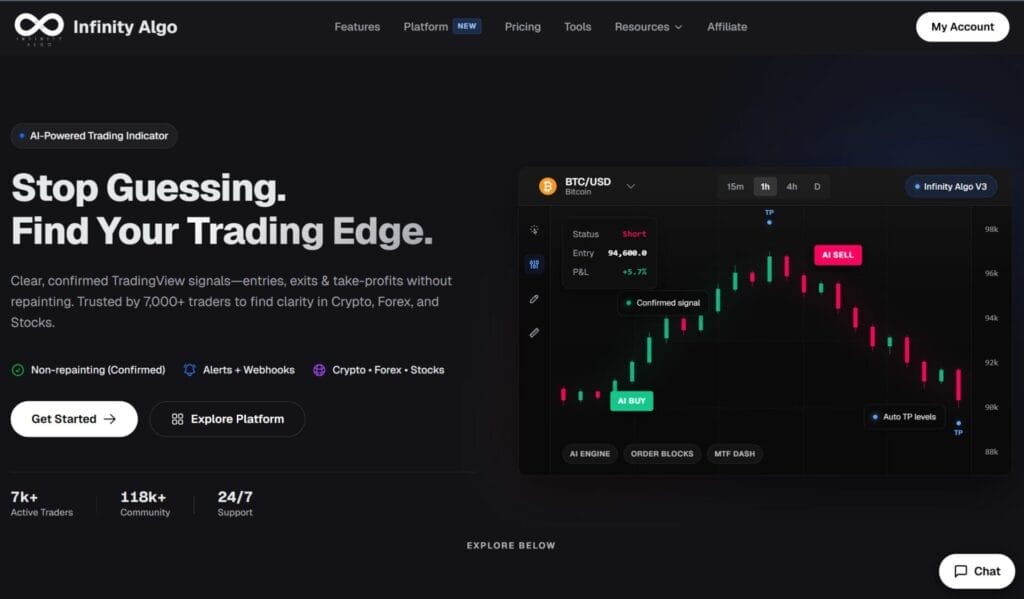
Infinity Algo positions itself as more than a TradingView indicator by combining signal generation with a broader web-based trading suite, AI analyst features, risk-planning tools, and multi-market support. Its official messaging highlights non-repainting buy and sell signals, take-profit and stop-loss alerting, pre-signal warnings, and a platform layer designed to help traders plan, execute, and review trades more systematically. In practical editorial terms, Infinity Algo reads as a hybrid between an all-in-one signal system and a companion decision-support platform, making it appealing to traders who want guidance beyond chart overlays alone.
Also,you may read Top 10 PolyMarket Analytics Tools
LuxAlgo vs. EzAlgo vs. SMRTAlgo vs. Infinity Algo: Key Features
LuxAlgo
- Broad TradingView indicator suite with premium algorithms, scanners, and chart-based analysis tools.
- AI backtesting that lets users generate, test, and refine strategies with optimization support.
- Real-time, test-synced alerts that can be routed to email or webhooks for execution workflows and automation.
- Strategy-building workflow that extends beyond signals into deployment and tuning inside TradingView.
- Large indicator library and ecosystem-style product structure for traders who want depth rather than a single-purpose script.
Also, you may read LuxAlgo vs. TrendSpider vs. Trade Ideas — Which Trading Tool Is Actually Worth Paying For?
EzAlgo
- AI-driven buy and sell signals designed to reduce emotional decision-making on TradingView charts.
- Real-time market tracking with proprietary entry and exit points.
- Multi-timeframe support and resistance zones for broader trade confirmation.
- Auto golden pocket functionality to help traders identify retracement-based opportunity zones.
- Coverage across markets available on TradingView, including stocks, crypto, forex, futures, and commodities.
- Messaging centered on accessible, plug-and-play signal usage rather than a heavier research or quant workflow. This is an editorial inference from the product pages.
Also, you may read LuxAlgo vs. Zeiierman vs. AlgoAlpha vs. Indicator Vault — Best Premium TradingView Indicator Suite in 2026
SMRTAlgo
- Real-time buy and sell signals built around AI, market structure, and smart money concepts.
- Smart-money detection to highlight areas where larger players may be active.
- Support and resistance zones, supply and demand areas, and auto trend lines for contextual trade analysis.
- Momentum-shift detection aimed at helping traders anticipate changes earlier with more confluence.
- AI-backed strategy generation and real-time risk control inside TradingView.
- All-in-one suite positioning for traders who want institutional-style chart structure without needing to code.
Also, you may read Top AsterDEX Alternatives
Infinity Algo
- Non-repainting buy and sell signals for clearer chart-based execution.
- Three-part TradingView suite including the main signal indicator, a backtest tool, and a multi-timeframe dashboard.
- Web-based AI platform with tools such as AI Analyst, Crypto Radar, Market Pulse, Trade Planner, and Journal.
- Alert support for buy and sell signals, take-profit levels, stop losses, and pre-signal warnings.
- Multi-timeframe dashboard with configurable timeframes plus added market-structure and order-block analysis.
- Cross-market coverage for crypto, forex, stocks, and commodities with a workflow that extends beyond the chart.
Also, you may read Top 8 Polymarket Trading Terminals
LuxAlgo vs. EzAlgo vs. SMRTAlgo vs. Infinity Algo: Pricing
| Platform | Plan | Official Price | Billing Basis | Notes |
|---|---|---|---|---|
| LuxAlgo | Free | $0 | Lifetime / free access | Access to the LuxAlgo Library. |
| Premium | $39.99/month | Monthly | Advanced signals, alerts, and oscillator tools. | |
| Ultimate | $59.99/month | Monthly | Includes AI Backtesting plus Premium features. | |
| EzAlgo | Monthly | $75/month | Monthly | Standard monthly access. |
| Yearly | $600/year | Annual | Official site states 33% savings. | |
| Lifetime | $2,997 one-time | One-time | Current price shown on the pricing section of the official site. | |
| SMRTAlgo | Monthly | $87/month | Monthly | Standard recurring access tier. |
| Quarterly | $129.95 / 3 months | Quarterly | Roughly $43/month effective. | |
| Lifetime | $495.95 one-time | One-time | Lifetime access tier. | |
| Infinity Algo | Monthly | $69.99/month | Monthly | Starter plan. |
| Yearly | $299.99/year | Annual | Official page also frames this as $24.99/month billed yearly. | |
| Lifetime | $999.99 one-time | One-time | Lifetime plan on official product page. |
LuxAlgo vs. EzAlgo vs. SMRTAlgo vs. Infinity Algo: Comparative Analysis
| Factor | LuxAlgo | EzAlgo | SMRTAlgo | Infinity Algo |
|---|---|---|---|---|
| Core positioning | AI trading platform with indicators, backtesting, strategy building, and alert deployment. | TradingView-focused algorithmic signal suite built around simpler buy/sell decision support. | Smart-money-style indicator ecosystem emphasizing institutional footprints, liquidity tools, and screeners. | AI-powered signal platform combining TradingView indicators with a wider web-based trading suite. |
| Platform depth | Highest platform depth in this group because it extends beyond chart signals into AI backtesting and strategy deployment. This is an editorial inference from the official feature set. | More focused and lighter-weight, with the strongest emphasis on direct signal usability rather than research-stack breadth. This is an editorial inference from the official site language. | Deeper than a basic signal script because it layers market-structure and smart-money tooling around entries. | Broad workflow depth thanks to its separate platform layer, dashboards, and planning tools outside TradingView overlays. |
| Signal style | More system-oriented than pure signal-selling, with emphasis on strategy creation, testing, and synced alerts. | Direct buy/sell and reversal-style guidance is central to the offer. | Context-heavy signal framework built around smart money and structural confluence. | Non-repainting buy/sell alerts plus TP, SL, and pre-signal warnings. |
| Market-structure focus | Present, but not the main identity. LuxAlgo is broader than a single SMC-style framework. | Lower emphasis on structure-heavy analysis in official messaging. | Strongest market-structure and smart-money identity in this comparison. | Includes market-structure elements, but they sit inside a wider AI suite rather than defining the whole brand. |
| Alerts and execution readiness | Strong alert workflow with real-time, test-synced alerts and webhook delivery. | TradingView signal workflow is central, but official pages highlight trader usability more than advanced execution plumbing. | Built for active traders, though the official site highlights toolkit breadth more than advanced automation language. | Strong alerting story with buy/sell, TP, SL, and pre-signal warning support. |
| Main strength | Best for traders who want a serious ecosystem rather than a standalone indicator. | Best for traders who want a cleaner learning curve and fast signal usability. | Best for traders who want smart money context and institutional-style chart framing. | Best for traders who want indicators plus an external decision-support platform. |
Conclusion
LuxAlgo, EzAlgo, SMRTAlgo, and Infinity Algo all target traders who want faster chart interpretation and more structured decision-making, but they do not deliver value in the same way. LuxAlgo stands out as the most complete ecosystem for traders who want more than signals, especially if they care about backtesting, strategy development, and alert automation. EzAlgo is the more straightforward choice for traders who want cleaner plug-and-play signal assistance without committing to a broader platform workflow. SMRTAlgo is the strongest fit for traders who prefer smart money concepts, liquidity-based chart reading, and more contextual market-structure analysis. Infinity Algo sits between a signal service and a wider trading workspace, making it attractive for traders who want alerts, dashboards, planning tools, and additional workflow support beyond TradingView overlays.
Frequently Asked Questions
Which indicator is best for smart money concepts?
SMRTAlgo is the clearest smart-money-focused option in this group because its official positioning emphasizes smart money concepts, liquidity reactions, support and resistance structure, and momentum confirmation.
Which one has the most expensive lifetime plan?
EzAlgo has the highest lifetime price among the four based on the official pricing pages reviewed for this comparison.
Do non-repainting signals matter in this comparison?
Yes. Non-repainting behavior matters because traders want signals that do not change after the fact. Infinity Algo explicitly highlights non-repainting signals in its official messaging, which is a notable credibility point for signal-based traders.